By
CultX Team


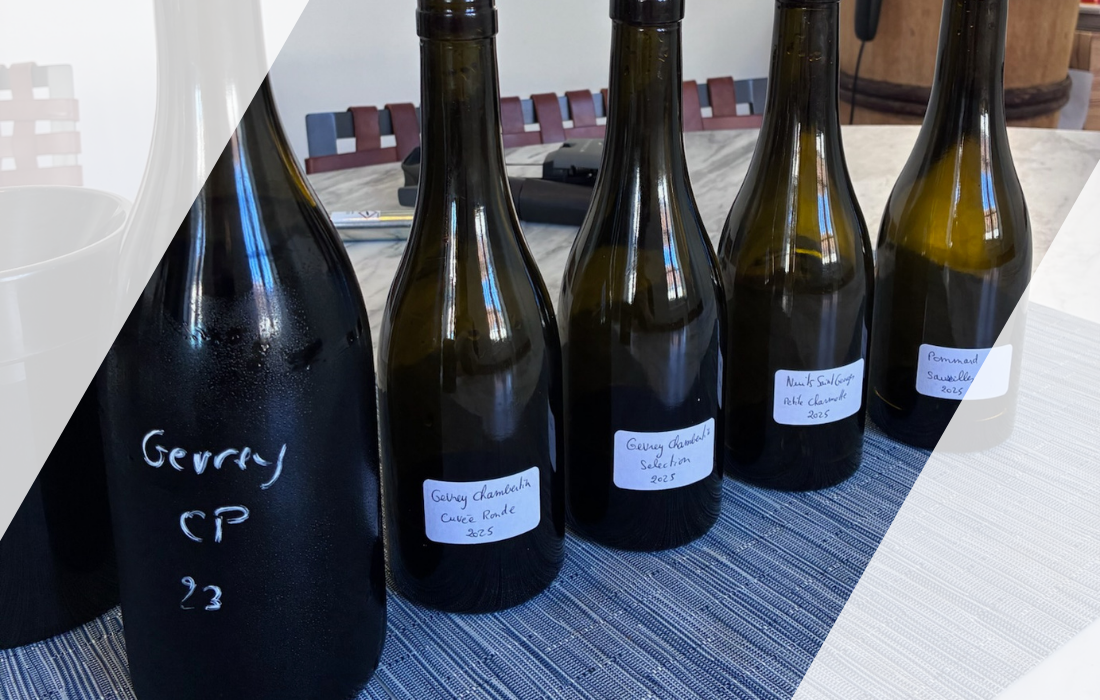
Some Burgundy visits are quiet, structured, almost choreographed. The visit with Pascal Marchand was none of those things.
For three hours, we tasted across nearly thirty wines, vintages, vineyards, and concepts. Pascal disappeared into the cellar to fetch one more bottle, then reappeared with a story about his neighbours, the Boisset family, the Burgundy of the 1980s, his sons. He has been making wine in Burgundy for forty-three years, and he still moves like a man arriving at a vineyard for the first time. The visit was, in a word, alive.
What follows is a portrait of one of Burgundy's most distinctive winemakers, told through a tasting that felt closer to an immersion.
Pascal's philosophy can be summed up in one of his own lines. "We do nothing the same. We like to have fun here."
It is the deliberate inverse of a formula. Where some Burgundy producers hold to a fixed method across every vintage, Pascal adapts. The whole-bunch percentage on a given cuvée is decided at the sorting table based on the look of the grapes, not on a recipe. The new oak ranges from zero on the regional wines to as much as 100% on certain Grand Crus. Two of his cuvées are made entirely without sulphur. Others have small additions at specific stages. He explained the logic simply: "We adapt to the year, to the vineyards, to what we think, to what we feel."
The result is a portfolio that feels less like a domaine and more like a body of work. Each wine is its own thing. Pascal himself is the connecting thread.
Pascal arrived in Burgundy in 1983, a Montreal-born former merchant marine and poet with no experience in wine. He worked the harvest with François Germain, took a course in viticulture and oenology in Beaune the following year while working at Domaine Bruno Clair, and in 1985, at twenty-nine, he was appointed winemaker at Domaine du Comte Armand in Pommard. He was only the second non-Frenchman ever to head a Burgundian estate.
He spent fifteen years at the Clos des Epeneaux, converting it to organic farming, lowering yields, and lifting the wines from relative obscurity to international acclaim. He was part of a generation of young winemakers who took over family domaines together in the mid-1980s, including Dominique Lafon, Christophe Roumier, Etienne Grivot, and Etienne de Montille. The group travelled and tasted in each other's cellars, and Pascal counts Henri Jayer among his great mentors.
In 1999 he left for the Boisset family to launch Domaine de la Vougeraie, which he converted to organic then biodynamic farming and which he led through the 2005 vintage. He emancipated himself in 2006 to launch his own micro-négociant business. In 2009 he partnered with the Canadian banker Moray Tawse, and the operation has been Marchand-Tawse ever since.

If there is a unifying winemaking principle across the range, it is one of restraint. "The winemaking is more and more doing less," Pascal said. Fewer punch-downs, fewer pump-overs, more of what he calls an infusion.
The thinking goes deeper than it sounds. By letting the polyphenols come out of the skins gently, without forcing them, Pascal believes he ends up with finer tannins. The cells are not broken open. The total polyphenols are the same, but they reach the wine in a more measured way. The wines we tasted bore this out completely. There is a transparency to them, a silky weight, a sense of fruit and structure layered without push.
The scale of the operation is genuinely difficult to grasp. Pascal farms ten hectares himself, which span twenty-one different appellations. He buys fruit for another thirty or so, often a single barrel at a time at the Premier and Grand Cru level. The total range runs to around fifty wines a vintage.
Some are tiny. The Musigny in 2022 was about 450 bottles. In 2016, around one and a half barrels. In 2024, a single half-barrel. Other cuvées are inventions. The "47 N" is a super-Bourgogne blend named after the National Route 74 that runs through the villages, including a Premier Cru element each year. The "Cuvée Ronde" is six lieux-dits of Gevrey-Chambertin co-fermented in one vat. Last year he bought the Pommard Saucilles vineyard he had been buying fruit from since 2019. Two-thirds of those vines are ninety years old.
Forty-three years in and Pascal is still trying things. Two wines are bottled without any sulphur addition. He still ploughs much of the estate by horse. He has been making Chardonnay and Pinot Noir in Western Australia under the Marchand & Burch label since 2007, taking massale selection cuttings from Burgundy and planting them in the ironstone soils of the Great Southern, half a world away from the limestone of the Côte d'Or.
When asked about his vision, he answered the way a winemaker who has spent forty years adapting tends to. Move from forty percent estate fruit to fifty-fifty. Find the ultimate Meursault. Maybe an Auxey-Duresses for the whites. Bring the sons properly into the business. The to-do list is long.
The proof is in the glasses. The Pommard Saucilles 2025 was perfumed in a way Pommard usually is not. The Mazis-Chambertin 2025, pulled from barrel, was sensational, with toasty oak and pure fruit and a length that lingered. The Morey-Saint-Denis Les Millandes 2024 had real poise and tension. The Clos Saint-Denis 2023 was ethereal, refined, light, with the extra gear of persistence that only Grand Cru fruit delivers.
Across the whole tasting, the wines felt unified by their lightness of touch and their absolute distinctiveness from each other. Which is the point. With Pascal, nothing is ever the same, and yet everything is unmistakeably him.
This article is for informational purposes only and does not constitute financial, investment, or regulated advice. Fine wine values can fall as well as rise. Past performance is not a reliable indicator of future results. Always conduct your own research before making any investment decision.

Four critics, 112 wines, one vintage: integrating Antonio Galloni, Neal Martin, William Kelley and Jane Anson with CultX release pricing to find where Bordeaux 2025 is mispriced.
Read more ➜
Verified marketplace data from CultX shows strengthening liquidity, rising bid competition and improving trading velocity as the fine wine market moves into a new phase of price stabilisation.
Read more ➜
A pre-release research briefing on the most anticipated Bordeaux vintage in years, built for investors and serious collectors using live CultX market data.
Read more ➜