By
Tom Gearing


Most Burgundy visits follow the same script. You arrive, you taste the latest release, you leave with one vintage's worth of impression and a vague sense of where the producer is heading.
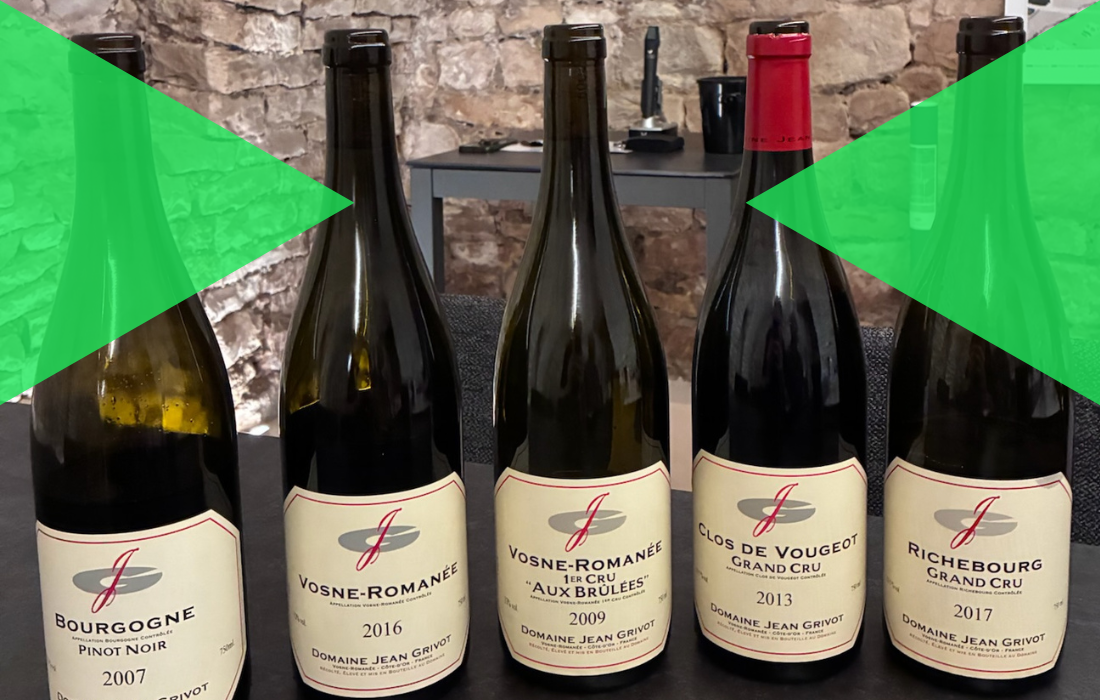
Domaine Jean Grivot does it differently. Thanks to Etienne Grivot's shop concept, Villa Velle, attached to the domaine and stocked with older releases, you can sit down and taste a producer across a decade. We spent a morning with Mia Cerutti, the domaine's host, tasting through Bourgogne 2007, Vosne-Romanée 2016, Aux Brûlées 2009, Clos de Vougeot 2013, and Richebourg 2017. Five wines, three appellations, eighteen years.
What follows is less a tasting note than a portrait of one of Vosne-Romanée's most quietly consistent domaines, told through the wines we actually opened.
If you ask Mia what makes a great winemaker, she has a clear answer. Consistency. A philosophy that holds across every vintage.
She calls it "fil rouge" or the "red line". The thread that should run through every wine a producer makes, year after year, regardless of whether the season was warm or cool, generous or short. As she put it: "It's really important for the winemaker to get a red line and a philosophy every vintage. Experimental approaches are welcome in Burgundy, like whole-bunch winemaking or others. But I don’t understand this desire to insist on whole-bunch winemaking at all costs, when many vintages simply don’t allow for it."
Her view on what defines a good winemaker is sharper still. "A great winemaker minimises the influence of the vintage without ever denying its character. The estate’s signature should remain evident, even in the most challenging years."
At Grivot, that signature is freshness, perfume, balance, and restraint. Wines with presence rather than weight. You can taste it in every glass.
The discipline behind the signature is straightforward. The same winemaking applies to every wine in the range, from the Bourgogne up to the Richebourg. 100% destemmed. No crushing. Gentle pumping over rather than punching down, often by hand. The full fermentation process lasts around 20 days, but during this time they carry out a cold pre-fermentation stage lasting around 5 days. Fifteen months in barrel, with one racking. Bottling in March, no filtration. New oak holds steady at 30%, with the rest of the barrels two or three uses old.
Four coopers split the new oak, all French wood from French forests: Chassin, Berthomieu, Ermitage and Cavin. The Richebourg gets four barrels, one from each. Grain and toast may vary slightly, but we’re looking at light, medium and blonde roasts. Each cooper brings subtle differences in tannin and flavour, and using all four is a way of balancing the signature.
The point is that nothing in the cellar is left to differentiate the wines from each other. Whatever shows up in the glass comes from the soil and the year. That is what gives the range its clarity.

Mathilde and Hubert took management of the domaine in 2022, having returned to work alongside Etienne from around 2010. Mia describes the handover as seamless, almost imperceptible. "Slowly," she says. No reset vintage. No big rupture.
The clearest sign of evolution is in the vineyard. They have moved most of the domaine from Guyot simple pruning, the Burgundy default, to Poussard, a more respectful approach that aims to extend vine longevity. Replanting is also done plot by plot now, swapping in individual tired vines rather than uprooting whole parcels, which is the opposite of the more dramatic gestures you see from larger neighbours.
Adaptation to a warming climate is happening, but quietly. Pinot Noir, as Mia notes, copes better than Chardonnay. There is no rush to redesign what is working.
Brûlées sits at the top of Richebourg, slightly above the road, and it does something the Grand Crus below it cannot. A natural break in the hillside, the Concoeur combe, channels cooler air down across the plot, lowering temperatures by a fraction of a degree and slowing maturity. In an earlier era of cooler vintages, that meant Brûlées sometimes struggled to ripen, which is part of why it was not classified Grand Cru. Today, with the climate warmer, that cooling influence is one of its best features.
You can taste it. The Aux Brûlées 2009 we drank had a wild, animal edge on the nose, ripe, almost barnyard, with a streak of freshness underneath that kept the wine pulling forward. It is a terroir that gives wine with character, not polish, and that suits this domaine's hand.
The Bourgogne Pinot Noir 2007 was the surprise. At eighteen years from a difficult vintage, half-bottle or not, it had moved into proper secondary territory, with stewed red fruit, lifted acidity, and a freshness that was not what you expect from a regional. The Vosne-Romanée 2016 was pretty, perfumed, juicy, with a touch of tannin on the finish reminding you it has decades ahead. Aux Brûlées 2009 had the farmyard intensity already mentioned. Clos de Vougeot 2013 was elegant rather than structured, with a perfumed nose, real depth and width across the palate, and a delicacy that surprised given the appellation's reputation for power.
And the Richebourg 2017. Only 1,000 bottles made on an average year. Lifted aromatics, a curl of red fruit and spice, beautiful purity, with a driving and persistent core of acidity carrying the wine across the palate. The Richebourg was a moment.
If you taste Grivot over eighteen years across regional, village, Premier Cru, and two Grand Crus, you find the same thread in every glass. Perfume. Freshness. Restraint. Presence without heaviness. That is the red line.
Few domaines let you test their philosophy this way. Most ask you to take it on trust. Grivot opens the bottles and lets the consistency speak for itself.
This article is for informational purposes only and does not constitute financial, investment, or regulated advice. Fine wine values can fall as well as rise. Past performance is not a reliable indicator of future results. Always conduct your own research before making any investment decision.
A morning in Morey-Saint-Denis with Alec Seysses, tasting the 2024s and reading a domaine through the lens it knows best: tannin, whole cluster, and quiet conviction.
Read more ➜
How a methodical obsession with reduction, lees ageing, and a "clean page" cellar is shaping some of Meursault's most distinctive, ageable whites.
Read more ➜
Discover Lafite Rothschild 2019: Perfect scores, high liquidity, undervalued with significant appreciation potential — this is a stellar investment. Start trading today with CultX.
Read more ➜