By
Tom Gearing


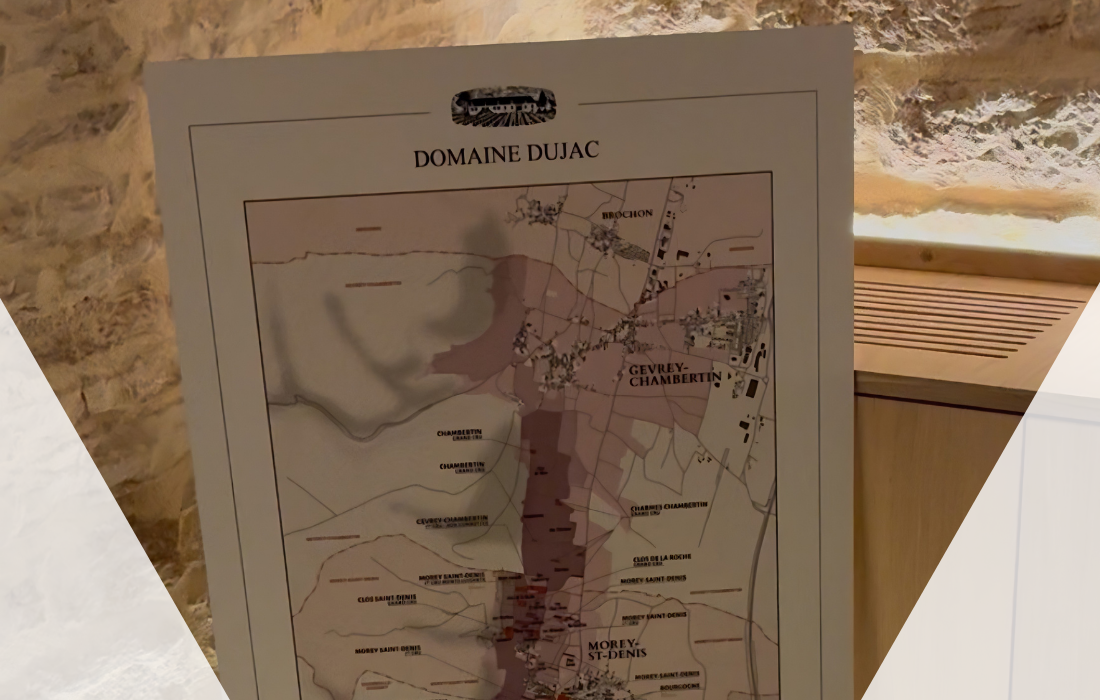
There are domaines you visit to understand a region, and there are domaines you visit to understand a philosophy. Dujac is firmly in the second camp.
Founded by Jacques Seysses in 1968 and now led by his sons Jeremy and Alec, the domaine has spent half a century building one of the most distinctive voices in Burgundy. The wines are aromatic, lifted, and unmistakably their own. I spent a morning in Morey-Saint-Denis with Alec, tasting through the 2024s and a couple of older bottles served blind. What follows is less a tasting note than a portrait of a domaine that knows exactly what it wants to make.
If you had to summarise Dujac in two words, it would be whole cluster. Across every red we tasted, the stems are there. Not as a rustic edge, but as a thread of spice and aromatic lift that runs from the village wines through to the Grand Crus. It's a stylistic choice the domaine has held to for decades, and the result is wines that feel bright, refined, and unusually expressive in their youth.
You can taste it most clearly in the contrast between the wines. The Morey-Saint-Denis village offers crunchy red fruit, a hint of coffee, and that signature spice in a more direct frame. By the time you get to the Grand Crus, the spice becomes one note among many, a layer rather than a lead, but it's always there.
What struck me most about tasting with Alec is how often the conversation came back to tannin. It's his primary lens. The way he reads vintage, terroir, ageing, and even his own winemaking decisions.
On the 2024s, he was specific: the tannins are present, but not as long or as large as 2022 or 2023. The vintage carries more acidity, and that combination of ripe fruit, slightly lighter tannic frame, and brighter acid is what gives the 2024s their finesse and tension. Lighter than the bigger years, but not light.
On Vosne-Romanée, he describes the signature as soft, silky tannin with underlying power. The Malconsorts is the proof: silky, precise, with that quiet structure beneath. The same logic shapes the cellar work. Where tannin quality is high enough, he'll push extraction a little further. For Malconsorts in particular, he uses light punch-overs to wet the cap rather than extract, trusting the quality of the tannins to do the work.
And when we got to the older wines, tannin was again how he framed evolution. The softening of tannin is what tells him a wine has moved through its awkward middle phase and into proper tertiary territory. As he put it, structured vintages need time to digest their own tannins, which is why great years can taste closed for a decade or more before opening into something extraordinary.
Once you start listening for it, the framework is everywhere. It's how Alec assesses what a wine is, and what it will become.

One of the more interesting wines in the line-up was the Gevrey-Chambertin 1er Cru Aux Combottes, and the story behind it is pure Burgundy. The vineyard sits right on the boundary between Gevrey and Morey, and if the lines had been drawn slightly differently, it would have been a Morey Grand Cru. Most of the producers and owners with land in Combottes are actually based in Morey, which adds to the sense that it belongs there in spirit if not on paper.
Alec is candid about it: he sees Combottes as a very strong Premier Cru sitting on the border of Grand Cru quality. In the glass it shows. Silky, elegant, beautifully balanced, with that touch of stem on the nose and a fine-grained, properly elegant tannic frame. It's the kind of wine that rewards a little reading before drinking.
The masterclass moment came with Clos de la Roche and Clos Saint-Denis tasted side by side. Both Grand Crus, both Dujac, both 2024, but two distinctly different wines, and Alec walked us through why.
Clos de la Roche covers both the top and bottom of the slope. The lower section carries more clay, which lends power and generosity. The upper section sits closer to the limestone bedrock, which brings finesse. The wine combines the two: bright red fruit, real density on the mid-palate, but elegant with it.
Clos Saint-Denis is almost entirely upper slope. Less power, more delicacy, and a microclimate quirk that adds another layer.
A break in the hillside funnels cold air down across the vineyard, contributing a fraction of a degree of coolness that shapes the wine over time. In the glass it was the more lifted of the two, red-fruited and floral on the nose, with a long, savoury finish wrapped in fruit. The standout of the flight, for me.
The 2024s are markedly different from the bigger, denser 2022s and 2023s that came before them. The fruit ripened well, but the vintage carries more acidity, and that translates into wines with real tension, finesse, and energy. The Vosne-Romanée 1er Cru Malconsorts in particular was striking: super expressive, precise, silky, with darker fruit and a savoury edge that gave it real depth.
Alec's view is that these wines should drink earlier than the 2022s or 2023s, but will still age comfortably for decades. He gave his usual rule of thumb, five years for village wines, seven to ten for Grand Crus, but added that 2024 is a vintage he genuinely wants to drink. That's worth listening to.
Some of the most revealing detail came when Alec talked about his approach to winemaking. Around 70% new oak across the reds. 100% whole cluster. Barrels sourced through Rémond, with first pick of the wood from a long-standing relationship, because, as he put it, a great wine in a poor barrel is like a great dish on a dirty plate.
He's also pragmatic. He's wound down the négoce side of the business (the wines produced from purchased grapes) because the quality of the grapes available wasn't meeting his standard. Where he once made the equivalent of five or six hectares of négoce wine, he's now down to three or four barrels, sourced from two retired growers whose vineyards he trusts completely. It's a decision about standards, not scale.
We finished blind with two older wines. The first, an intermediate-aged bottle with maximum secondary aromas, turned out to be the Malconsorts 2016. Still youthful, still complex, still showing fruit. The second was older and fully tertiary: a Bonnes Mares 1996, with the high acidity that defines that vintage giving it precision and freshness three decades on. The tannins had softened completely, exactly as Alec described. That final marker of a wine fully arrived at its tertiary phase.
It was a useful reminder of what these wines become with time. As Alec put it, his father always said you should make wine for drinking, not for tasting. That ethos of wines that come alive over the course of a meal, wines that reward patience and good company, runs through everything Dujac does.
If you want to understand why Burgundy lovers talk about Dujac the way they do, drink the wines. And then drink them again in ten years.
This article is for informational purposes only and does not constitute financial, investment, or regulated advice. Fine wine values can fall as well as rise. Past performance is not a reliable indicator of future results. Always conduct your own research before making any investment decision.
Analysis across 30 vintages, combining critic scores, trade data, and pricing trends to highlight investment opportunities in the secondary fine wine market.
Read more ➜
Market analysis covering critic scores, pricing trends, and performance across 25 vintages. Identify undervalued opportunities and key investment insights within the Bordeaux market.
Read more ➜
Discover Lafite Rothschild 2019: Perfect scores, high liquidity, undervalued with significant appreciation potential — this is a stellar investment. Start trading today with CultX.
Read more ➜