By
CultX Team


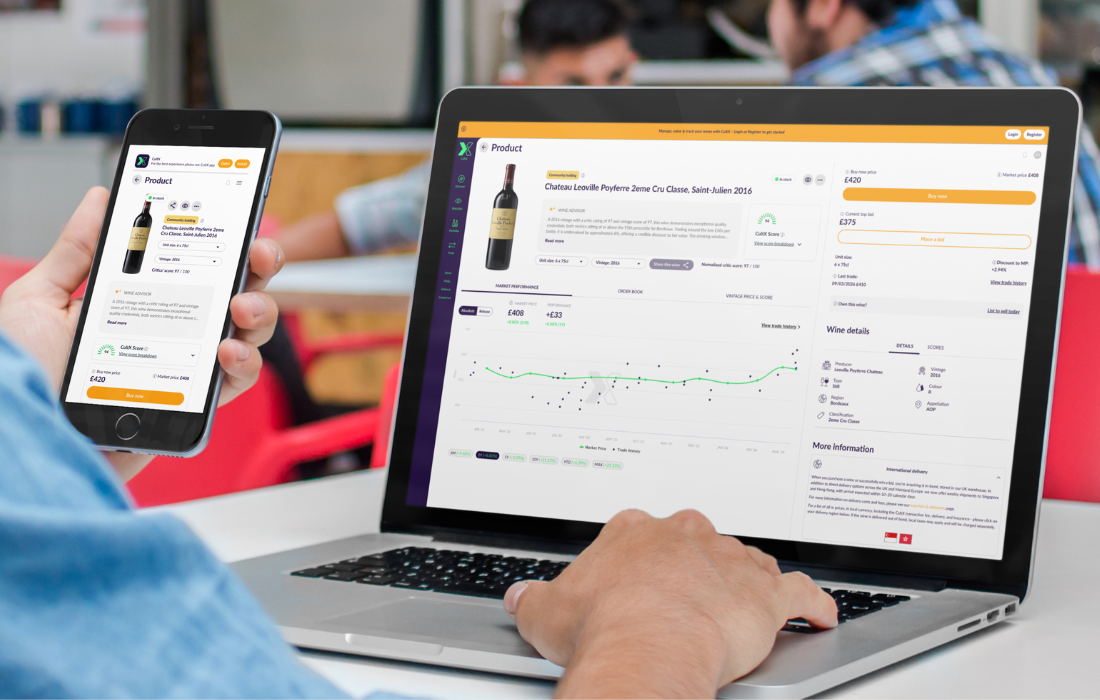
After nearly three years of price correction across the fine wine market, behavioural indicators from trading venues are beginning to point towards a shift in sentiment. While benchmark indices such as the Liv-ex Fine Wine 100 have only recently recorded consecutive months of positive performance, activity on live trading platforms is often where meaningful changes become visible.
On CultX, the world’s only 24/7 fine wine trading marketplace, verified transaction data shows a clear strengthening in participation across both buying and selling since late 2025. Because every listing, bid and completed trade represents a real-money interaction between market participants, these metrics provide a real-time view of confidence levels that can precede broader index movements.
“Improving liquidity and competitive bidding dynamics can signal turning points in the fine wine market before index recovery becomes fully established.”
Several key indicators have moved materially since the start of 2026.
Gross Merchandise Value (GMV) on CultX has increased 180% since the end of 2024, reflecting a substantial rise in the total value of wine changing hands on the platform. At the same time, new user registrations accelerated sharply, with February 2026 sign-ups more than doubling compared with November 2025. This represents the fastest rate of participant growth since the marketplace launched.
Importantly, this growth is not occurring in isolation. It is accompanied by rising trading engagement across existing users, suggesting that both new and experienced collectors are becoming more active as pricing conditions stabilise.
Bid participation metrics reinforce this view. Currently, 57% of wines listed on CultX attract active bids, equating to more than 2,700 individual markets where buyer interest is visible. Within that group, 44% of listings are experiencing competitive bidding dynamics, meaning multiple buyers are actively competing for the same wine.
This convergence of rising buyer demand with increasing seller participation is a defining feature of liquid markets. During the earlier stages of the correction cycle, activity was often characterised by one-sided selling pressure and limited price discovery. The current environment appears more balanced, with pricing increasingly determined through genuine negotiation between participants.
Another important indicator is trading velocity, the speed at which listings move from offer to execution. Although fine wine markets naturally trade less frequently than equities or digital assets, recent data suggests improving execution conditions across multiple price segments.
For marketplace users, stronger liquidity has practical implications. It can reduce the time required to exit positions, improve confidence in price transparency and create more opportunities to reposition portfolios in response to evolving market signals.
These behavioural shifts align with patterns observed in previous fine wine market cycles.
During downturns in 1997, 2008, and 2011, transactional activity began to recover before index performance turned decisively positive. While it would be premature to characterise current conditions as a full market recovery, the strengthening activity visible on CultX suggests that the market may be moving into a new phase, one defined less by forced repricing and more by selective re-engagement.

While broad index movements remain relatively modest, verified transaction data from live trading venues is beginning to reveal where pricing momentum is already emerging. Recovery in the fine wine market rarely occurs in a uniform or synchronised way. Instead, it typically starts with selective re-engagement in wines that combine strong brand recognition, proven ageing potential, and historically deep secondary market demand.
Recent trading activity on CultX clearly illustrates this pattern. Because all prices reflect completed transactions between buyers and sellers, they provide a more immediate view of market positioning than indicative mid-market valuations.
These examples highlight how pricing recovery is currently concentrated within recognised blue-chip producers and benchmark vintages. Such wines often act as liquidity anchors during periods of market transition, attracting early buyer interest as participants reassess value following a correction cycle.
Independent market data provides further context. According to Liv-ex, the Fine Wine 100 index has risen approximately 3.9% over the past six months, representing the first sustained positive movement since the market peak in 2022. Regional benchmarks, including the Champagne 50 and Italy 100, have also posted incremental gains year to date.
Today’s trading patterns suggest the emergence of a more fundamentals-driven market. Buyer demand is increasingly focused on wines with established track records, favourable drinking windows, and historically resilient secondary market liquidity.
Beyond pricing signals and selective recovery patterns, one of the most important developments shaping the fine wine market today is the continued evolution of trading infrastructure. Historically, the secondary market for fine wine has been fragmented, characterised by periodic auction cycles, opaque pricing and limited visibility into real-time supply and demand dynamics.
The emergence of live trading environments such as CultX represents a structural shift in how fine wine is transacted. By providing continuous access to over 12,000 active wine markets, the platform enables participants to observe price formation in real time rather than relying solely on retrospective auction results or indicative broker pricing.
This increase in transparency contributes to more resilient market behaviour during periods of volatility. When buyers and sellers can respond dynamically to changing conditions, pricing adjustments tend to occur more gradually and reflect a broader range of participant views.
As broader indices stabilise, marketplace behaviour is likely to remain one of the clearest indicators of how the fine wine cycle is evolving. Rising bid participation, improving liquidity, and expanding platform engagement suggest the market may already be transitioning from a correction to a reallocation.
For collectors and investors, real-time trading signals are becoming an increasingly important lens through which to interpret risk, pricing and opportunity as the market moves through 2026.
*Past performance is not indicative of future success; the performance was calculated in GBP and will vary in other currencies. Any investment involves risk of partial or full loss of capital.
With lower prices, renewed demand and improving market signals, 2026 is shaping up to be a standout year for collectors and investors.
Read more ➜
CultX makes wine investing smarter with tools to track prices, market trends, and valuations. Easily manage your portfolio, explore live data, and stay informed.
Read more ➜
Maximise your wine trading by leveraging our unique tools like live offers, community holdings, order books, and liquidity scores, all designed to connect you with motivated buyers and sellers.
Read more ➜