By
CultX Team


Table of Contents
A four-critic analysis of the Bordeaux 2025 vintage with live CultX market data. Antonio Galloni (Vinous), Neal Martin (Vinous), William Kelley (Robertparker.com) and Jane Anson (Decanter) have published their scores and tasting notes.
We have the entire CultX En Primeur universe of 112 wines mapped against the panel, the +5% expected release prices, and the historical performance of each wine across the 2019, 2020 and 2022 vintages. This is the integration.
All prices in GBP, in-bond, per six-bottle case. +5% pricing reflects an expected 5% increase versus 2024 release. Average critic score is the midpoint of each critic's range across all available critics for that wine. Direct quotes from critics are reproduced under licensed access to Vinous, Robertparker.com and Decanter.
Bordeaux 2025 has been comprehensively assessed by the four most influential English-language critics writing on the region. The headline numbers tell a clean story. Margaux averages 98.12 across all four critics, the highest score in the vintage. Haut-Brion is at 98.00 across all four. Montrose at 97.75. Thirteen wines achieve a four-critic (or three-critic, where one had not covered the wine) average of 97 or above. A further twenty-two sit between 96 and 97. The vintage does not lack for greatness.
But the more interesting story sits underneath the averages. The four critics disagree, sometimes profoundly. Galloni and Martin work for the same publication and arrive at scores three or four points apart on multiple wines. Kelley calls Pontet-Canet "one of the wines of the vintage" with a 98-100 score; both Vinous critics sit at 94-98. Martin gives Lafite 98-100; Kelley gives it 95-97. Same wine, same vintage, same week of tasting, fundamentally different reactions.
This matters for buyers because critic disagreement is where the secondary market gets re-priced. Where a panel of four critics converges, the market converges with it and the price is what it is. Where a panel of four critics diverges, the wine eventually has to settle on one side or the other, and the buyer who calls that direction correctly captures the spread.
This article does four things. First, it integrates the four-critic data with CultX's expected +5% release pricing to produce a scored hierarchy of the 2025 vintage that uses scores and prices together rather than either alone. Second, it explicitly revises the investment-case verdicts we published in our pre-release analysis. Several wines we placed on the Avoid List on pure pricing logic now demand a different reading once score data is layered in. Third, it identifies the wines where critic language is meaningfully more enthusiastic than scores would suggest, the language sleepers. Fourth, it isolates the eight wines where Kelley and Martin, the two critics whose scores have historically moved fine wine prices most reliably, both score at 96 or above with close agreement. We treat that subset as the investment-grade core of the vintage.
Track every Bordeaux 2025 release with live pricing, four-critic scores and bid activity on the CultX En Primeur Pricing Tool.
The four critics whose data underpins this analysis are not interchangeable. They write for different publications, score on different scales of generosity, and weight the same qualities differently. A serious analysis of Bordeaux 2025 cannot treat their scores as four independent measurements of the same underlying truth. They are four distinct readings of the vintage, and the spread between them is itself a piece of information.
Galloni is the founder and publisher of Vinous, and the most senior English-language voice on Bordeaux still tasting in barrel. His scoring tends to run slightly more generous than the panel average across the 2025 vintage; his tasting notes lean toward stylistic and emotional language. He uses words like "dazzling," "compelling," and "unforgettable" sparingly enough that when he reaches for them, the signal is meaningful. On the 2025 Cos d'Estournel he wrote: "the 2025 Cos d'Estournel is shaping up to be one of the wines of the vintage. Grand, dramatic and sweeping, with notable textural intensity," then closed with one word: "A masterpiece." That is the strongest endorsement he has given any wine in the campaign.
Martin is the second senior Vinous voice on the vintage, having joined the publication in 2018 after a long tenure at Robertparker.com. His scoring is more conservative than Galloni's across 2025: only three wines (Lafite, Haut-Brion, Montrose) earned a 98-100 band. His notes are more analytical, structurally focused, and frequently set the wine in comparison to specific recent vintages of the same property. On the 2025 Lafite he observed that the wine "will drink earlier than the 2022, yet will age with equal grace in bottle." On Haut-Brion he wrote that it is "a little more refined than, say, the 2020 or 2022," explicitly placing the 2025 above two of the strongest recent vintages.
The presence of two senior Vinous critics on the same vintage, scoring and writing independently, is unusual and analytically valuable. It allows a check on the publication's house view. Where Galloni and Martin agree, the Vinous reading is robust. Where they diverge, the disagreement reveals something about the wine itself.
Kelley scores tougher than the Vinous critics on 2025: his average score across the wines he covered runs roughly a point below Galloni's and Martin's averages. His notes are technically dense, frequently citing specific blend percentages, IPT measurements, picking dates, and viticultural changes. His superlative language is rationed. When Kelley writes that a wine is "one of the wines of the vintage" or "one of the finest wines this estate has produced," he means it as a structural claim. His call on Pontet-Canet, "the 2025 Pontet-Canet is one of the finest wines this estate has produced" coupled with a 98-100 score, is the most decisive single endorsement in the entire campaign.
Anson is the most internationally focused of the four critics, writing for Decanter and through her own platform. Her published scores on 2025 are point scores rather than ranges, and she covered substantially more wines (her dataset includes scores across all 100 wines we cross-referenced). She scores at a similar level to the Vinous house, though with less stylistic divergence between her highest and lowest scores. Her 98-points-or-higher list is short and unsentimental: Margaux, Mouton, Cheval Blanc with caveats, Haut-Bailly, Cos d'Estournel, Smith Haut Lafitte, Calon-Ségur, Léoville-Las-Cases, Figeac.
Reading across all four critics, certain language patterns recur. Notes describe a vintage with high acidity, moderate alcohol (most reds between 12.7 and 13.8 percent), and tannins that critics across the panel describe variously as "fine," "chiselled," "filigree," "supple" and "refined" rather than the heavier descriptors that have characterised some recent warm vintages. Picking dates were spread, with several estates harvesting from late August into late September, allowing different parcels to ripen at their own pace. Yields are universally low: 22 hl/ha at Margaux, 25 at Figeac, 27 at Lafite, 26.6 at Haut-Bailly, 15 at Cheval Blanc, that last figure the lowest at the property in living memory.
The structural read on the vintage from the panel is unambiguous. This is a classical Bordeaux with restrained alcohol, real freshness, and built for long ageing. It is the kind of vintage Bordeaux's traditional buyers have been waiting to see again.
Our pre-release analysis of Bordeaux 2025, published before any critic scores were in, used a disciplined IRR model to assess each wine in the CultX En Primeur universe. The model worked as follows: take the expected +5% release price, apply a 7 percent annualised return target over three years, add storage, and compare the resulting target exit price against the current secondary market prices of the 2019, 2020 and 2022 vintages of the same wine. Where the target sat below the lowest comparable vintage price (the downside floor), we called the wine a Strong Buy. Where it sat above all comparable vintage prices, we called it Avoid.
The model produced a specific verdict structure: two Tier 1 conviction names (Mouton-Rothschild, Cheval-Blanc), eight Tier 2 buys, a Watch List of names where pricing risk dominated, and an Avoid List for any wine where the IRR target couldn't be supported by comparable vintage values.
That model was correct given the inputs available. With score data now in hand, several of those verdicts demand revision.
The reasoning in the original article was that wines whose 2022, 2020 and 2019 secondary market prices sat near or below the +5% entry price had no meaningful upside without a re-rating event. A re-rating event is exactly what 98+ critic scores represent. A wine scoring at the top of the panel doesn't trade at the level of its own 95-point predecessor; it sets a new floor. When we placed these wines on Avoid, we did so without that data.
Troplong Mondot is the most striking case. Both Galloni and Kelley call it "one of the wines of the vintage." Martin calls it "one of the finest Troplong Mondots to date." The four-critic average is 97.50. The +5% release is £465. We had this wine on Avoid because its 2022 and 2020 vintages currently trade at £475 and £299 respectively, sitting around or below the +5% entry. The model said no margin. The score data says the floor has moved.
Canon is a parallel case. Galloni at 98-100, Kelley with the line "the 2025 Canon continues this property's brilliant decade-long run of exceptional wines," Martin at 96-98, Anson at 97. Four-critic average 97.62. At £465 entry, with a similar comparable-vintage profile to Troplong Mondot, this was an Avoid on the model. Both Vinous and Robertparker.com put it in territory where the comparable 2022 (£390) becomes irrelevant as a floor.
Pontet-Canet is the most extreme case of language-led re-rating. Kelley wrote: "It stands as one of the wines of the vintage. The 2025 Pontet-Canet is one of the finest wines this estate has produced." Coupled with his 98-100 score and his observation that "biodynamic viticulture, gentle extraction methods, and bespoke bottling practices… have conspired to take this estate to new heights of quality and consistency," that's the most decisive critic endorsement of any wine in the campaign. Both Vinous critics scored the wine more conservatively (Galloni 96-98+, Martin 94-96), so the four-critic average lands at 96.75 rather than 98+. The +5% release at £388 was an Avoid on price; on Kelley's reading alone, it is a conviction buy. We will treat this as a Tier 2 with a Kelley conviction overlay.
Smith Haut Lafitte is the price-led story. Anson at 98 (her equal-highest score in the dataset), Martin at 95-97, no Galloni or Kelley note. At £403 the +5% entry sits below the 2020 secondary market of £366 only narrowly, but Anson's 98, a critic who is unsentimental about the upper band, re-rates this wine. Two-critic coverage limits how confidently we can call it, but the data we have is unambiguous.
Haut-Bailly rounds out the major revisions. Anson 98-100 (her highest score band), Martin "this ranks amongst the best vintages from Haut-Bailly in recent years," Galloni 95-97. Three-critic average 97.33. At £372 entry, the wine's 2022 vintage is down 50 percent from EP and currently trades around £305. The model said the floor was £305, the IRR target was £463, and the gap couldn't be closed. With three critics scoring at 95-97 or above and one at the maximum band, the floor is no longer £305.
The original Tier 1 holds up entirely. Mouton-Rothschild averages 97.50 across all four critics, with Anson at 98-100. Cheval-Blanc averages 97.12 across all four; Kelley wrote that it "stands out once again as among the finest wines of the vintage in Bordeaux" with a 98-100 score, and that "the 2025 gives every indication of being one of the great Cheval Blancs of the decade." Lafleur averages 97.67 across the three critics who scored it; we maintained a model override on Lafleur in the original article because of its track record (+134 percent from 2019 EP, +26 percent from 2022 EP) and the override is now textually supported as well as historically.
The original Tier 2 also strengthens. Haut-Brion moves from Tier 2 to Tier 1 on the score data alone. Both Martin and Kelley deliver 98-100 scores, Anson at 97, Galloni at 96-98. Four-critic average 98.00, the joint-highest in the vintage. Kelley wrote that it "stands as one of the more impressive renditions of Haut-Brion in recent years." Martin observed that the 2025 is "a little more refined than, say, the 2020 or 2022," those being two of the strongest recent Haut-Brion vintages by score.
Léoville-Las-Cases averages 97.25 across all four critics with a score range of just 1.0, three critics at 96-98, Anson at 98. The tightest panel agreement in the upper tier, at £621 entry. Kelley described it as "one of the most serious, brooding wines of the vintage."
Figeac averages 97.50 across all four critics, again with a score range of just 1.0. Kelley: "this integrated and balanced Figeac is a serious wine, built for the long haul." Anson at 98. The panel agrees, the price at £621 is the same as Las Cases, and both are conviction-grade buys.
The Watch List partially holds. Pichon Baron averages 96.75 across all four critics, with Kelley calling the wine "a brilliant achievement" and Martin observing that it "might be earlier drinking than the 2019 or 2022. Superb." The score data and the language both support taking Pichon Baron off the Watch List and placing it in Tier 2. Lafite averages 97.50 with Martin at 98-100, Galloni at 97-99, Kelley at 95-97 and Anson at 97. The Vinous house view is unambiguous; only Kelley pulled back. The wine's long-term EP performance has been negative (down 31.5 percent from 2022, down 9 percent from 2019) but at 97.50 panel average, the case is materially stronger than it was on price alone. Off the Watch List, into Tier 1.
Beychevelle stays on the Watch List. Galloni and Martin both at 95-97 and Galloni described it as "one of the finest in recent memory," but Kelley pulled back hard to 92-93 and Anson sat at 93. Four-critic average just 94.38. The Vinous critics see something the other two don't, and at £368 the asymmetry doesn't quite work without further data.
The Avoid List shrinks materially. The wines that genuinely remain Avoid on both score and price grounds are Léoville-Barton (avg 95.50, comparable vintage compression), Quintus (no critic coverage in the top 100), La Mondotte (avg 95.00, two critics only, price premium not supported by score) and the second wines / Pavillons (Carruades de Lafite, Clarence Haut Brion, Le Petit Mouton, Aromes de Pavie, Pavillon Rouge, these all show IRR targets above their comparable vintage ceilings without offsetting score upgrades).
The intellectual honesty here matters. The original article called the model correctly given its inputs. With more inputs, the verdicts move. That is what good analysis does.
The most useful single visualisation of the 2025 vintage plots each wine's average critic score against its +5% release price. Because the price axis spans nearly two orders of magnitude (from sub-£100 to over £2,000 per six-pack), we use a log scale on price. The y-axis is the four-critic average score.
Average critic score across Galloni, Martin, Kelley & Anson against +5% expected release price
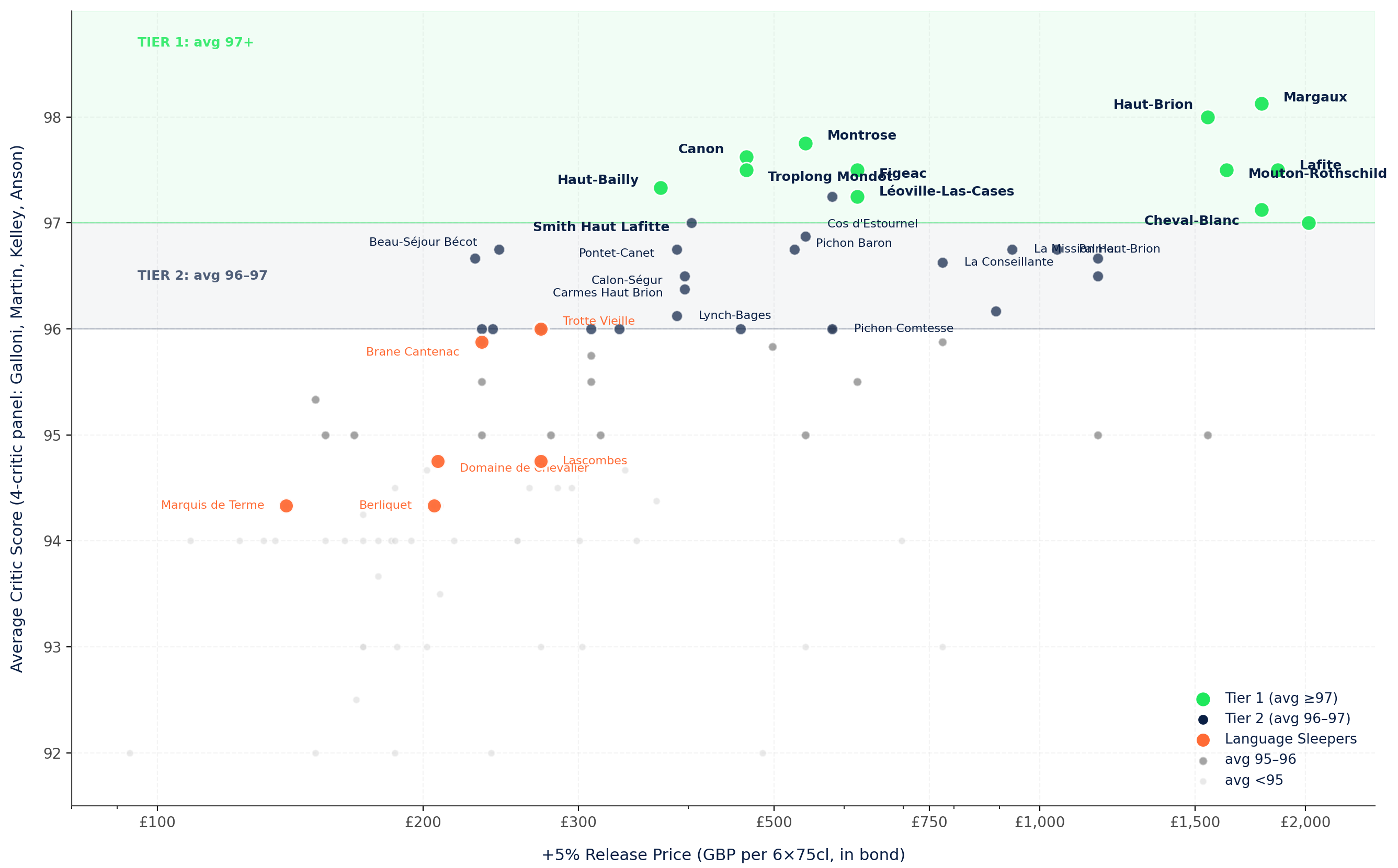
Source: CultX Research, May 2026. Scores per published critic reviews. Pricing is +5% of 2024 release in GBP per 6×75cl, in bond.
Reading the map, four regions stand out.
Top right: the First Growth tier. Margaux, Haut-Brion, Lafite and Mouton-Rothschild cluster at the upper right, all averaging 97.5 or above with prices £1,500 to £2,000. These are not value picks. They are conviction buys for collectors who want First Growth quality at a vintage where the price, on a relative basis to comparable First Growth vintages, is competitive. Cheval-Blanc sits with them at £1,784 and 97.12 panel avg.
Top centre: the value-conviction zone. This is where the strongest investment cases sit. Wines averaging 97 or above at prices of £400 to £700 per six-pack. Montrose at £543 / 97.75. Figeac at £621 / 97.50. Léoville-Las-Cases at £621 / 97.25. Troplong Mondot at £465 / 97.50. Canon at £465 / 97.62. Haut-Bailly at £372 / 97.33. These are the wines where the score data has fundamentally changed the investment thesis from the pre-release model.
Top left: the value cluster. Wines averaging 96 or above at prices below £400. Beau-Séjour Bécot at £244 / 96.75 is the most striking. La Gaffelière at £229 / 96.67. Pavie-Macquin at £233 / 96.00. Larcis-Ducasse at £240 / 96.00. Trotte Vieille at £272 / 96.00. Pontet-Canet at £388 / 96.75. Carmes Haut Brion at £396 / 96.38. Calon-Ségur at £396 / 96.50. Lynch-Bages at £388 / 96.13. These wines reward the buyer who isn't trying to assemble a First Growth-only cellar.
Lower left: the language sleepers. A scatter of wines averaging 94 to 96 priced under £300. Most are forgettable. Several aren't. Lascombes, Berliquet, Marquis de Terme, Brane Cantenac, Trotte Vieille (which sits at the boundary of this region and the Tier 2 cluster above), Giscours, Haut-Batailley, Lagrange and Laroque. These are the wines where critic language is meaningfully more enthusiastic than the score data suggests. Several show two-critic agreement on the trajectory or estate-historical framing. Section 6 covers them in detail.
The wines that don't make any of these clusters, the bulk of the chart, the grey points, are the bulk of any en primeur campaign. Most wines in most vintages do not represent compelling propositions on a price-to-quality basis. The selectivity is the point.
These are the thirteen wines where the four-critic panel average is 97 or higher, with at least three critics covering each wine. Listed in descending order by average score, with critic notes integrated and verdict updated.
The highest score in the vintage. Galloni 97-99, Martin 96-98, Kelley 97-100, Anson 98-100. Four critics, every one in or near the perfect band, range of just 1.5.
"The 2025 Château Margaux is shaping up to be one of the wines of this young vintage. Dark and layered, almost mysterious in bearing, the 2025 is going to have a lot to say over the coming decades as it grows up."
— Antonio Galloni, Vinous
"The first thing you notice is the purity of fruit, a signature of the First Growth but taken to its maximum in this vintage."
— Neal Martin, Vinous
"It is a prodigious Château Margaux in the making."
— William Kelley, Robertparker.com
Kelley specifies that the grand vin represents 37 percent of the estate's production at 13.8 percent alcohol and pH 3.72. Martin notes it was picked at 22 hl/ha between 10 and 29 September, matured in 100 percent new oak. Yields are tight, the panel agreement is exceptional, and at £1,784 entry the wine is below all three comparable vintage market prices (2022 at £2,100, 2020 at £1,950, 2019 at £1,950).
Verdict: Tier 1, Strong Buy.
Joint second by score, but the most direct claim of generational status from the panel. Martin and Kelley both at 98-100, Anson 97, Galloni 96-98.
"It stands as one of the more impressive renditions of Haut-Brion in recent years."
— William Kelley, Robertparker.com
"Wonderful delineation and a little more refined than, say, the 2020 or 2022."
— Neal Martin, Vinous
Martin's comparison is the analytical centrepiece. The 2020 Haut-Brion scored 100 at Wine Advocate; the 2022 scored 97-100. For Martin to position the 2025 as "more refined" than both of those is a structural claim, not an ornamental one. Kelley's note adds that IPT levels exceed 100, "rarely observed", Bordeaux's analytical measure of tannic concentration showing the 2025 is built for very long ageing. At £1,551 entry, the wine sits 9 percent below the 2020 market price (£1,703) and 23 percent below the 2022 market (£2,000). The downside floor is well above entry.
Verdict: Tier 1, Strong Buy.
The most significant verdict revision in this article. Montrose was a Collector's Pick in our pre-release analysis, included for quality and price even though the IRR model didn't make a conviction case. The score data has fundamentally changed this. Martin and Kelley both at 98-100, Anson 97, Galloni 95-97.
"This is a Montrose that will rank as one for the ages."
— Neal Martin, Vinous
"A timeless classic in the making."
— William Kelley, Robertparker.com
"One for the ages" is Martin's most superlative single phrase across the entire 2025 vintage. He uses it once. Kelley pairs it with "timeless classic," which is similarly rare in his vocabulary. The combination of two of the four critics delivering both perfect-band scores and historical language on the same wine is the strongest signal in the campaign for re-rating against the pre-release model.
At £543 entry, the IRR target is £672. Comparable vintage prices: 2022 at £660, 2020 at £582, 2019 at £600. The IRR target exceeds the 2022 ceiling by 2 percent. Without scores, this is a marginal case. With scores like these, and the historical performance record showing Montrose +1.5 percent from 2019 EP, the model assumption that the 2025 will trade at comparable vintage levels is wrong. A 98-100 Montrose with two critics calling it "one for the ages" trades higher than a 96-pointer.
Verdict: Tier 1, upgraded from Collector's Pick.
We maintained a model override on Lafleur in the pre-release analysis on the strength of its EP performance record (+134 percent from 2019, +26 percent from 2022). The override is now textually supported. Martin 97-99, Kelley 96-98, Anson 98. Galloni did not cover.
"What really marks this Lafleur is its tremendous persistence on the finish. It just goes on and on. This is a great Lafleur."
— Neal Martin, Vinous
Note Martin's observation that this is "the first year when the wine is classified as Vin de France after water was added to the soil, contravening Pomerol's AC rules." This is a significant administrative footnote, the 2025 Lafleur is technically declassified, but does not affect quality or price. Kelley calls it "a large-scaled Lafleur endowed with everything in abundance." The wine's track record makes the model arithmetic moot.
Verdict: Tier 1, Strong Buy.
The original Avoid List call. Now demonstrably wrong on score data. Galloni at 98-100, Kelley 96-99 with the line that this is the property's "brilliant decade-long run continuing," Martin 96-98, Anson 97.
"The 2025 Canon is a total stunner. The interplay of finesse and power is dazzling."
— Antonio Galloni, Vinous
"The 2025 Canon continues this property's brilliant decade-long run of exceptional wines."
— William Kelley, Robertparker.com
At £465 entry against comparable vintages of £570 (2022), £493 (2020) and £390 (2019), the IRR target of £577 sits above the 2022 ceiling. On the model alone, Avoid. With Galloni at the perfect band and Kelley placing this within an explicitly defined decade-long quality run, the comparable vintage prices are no longer the relevant floor. Canon at this score level trades higher than its comparable vintages did.
Verdict: Tier 1, upgraded from Avoid List.
The original Tier 1 conviction holds. Galloni 96-98, Martin 95-97, Kelley 97-99, Anson 98-100.
"There's a ton of potential here."
— Antonio Galloni, Vinous
"A little more rounded and suppler than the 2025 Lafite."
— Neal Martin, Vinous
Martin's comparison to Lafite is structurally interesting: both Vinous critics scored Lafite higher than Mouton on this vintage, though Kelley reverses the polarity. The 2025 Mouton is 98 percent Cabernet Sauvignon, "the highest Cabernet Sauvignon ever" per Martin. At £1,629 entry, the wine is below all three comparable vintage market prices. Martin notes it's a touch more flattering at this early stage than Lafite, which speaks to drinkability but not necessarily long-term superiority.
Verdict: Tier 1, Strong Buy. Confirmed.
Watch List in the original article on pricing risk grounds. Now upgraded. Galloni 97-99, Martin 98-100, Kelley 95-97, Anson 97.
"It is blessed with extraordinary harmony and it is so well balanced that you almost overlook the weight and minéralité towards the finish."
—Neal Martin, Vinous
"A Pauillac of mid-weight structure, the 2025 impresses with its tension and deep, layered personality."
— Antonio Galloni, Vinous
Martin's 98-100 is one of only three he gave to the entire vintage. He describes the wine as "very succinct and refined" and predicts it "will drink earlier than the 2022, yet will age with equal grace in bottle." That is two First Growth-level claims in one note. Kelley's restraint at 95-97 is the outlier on the panel; the Vinous house view is unambiguous, and the Anson and Galloni positions both lean toward Martin. The wine's long-term EP performance has been negative, but at 97.50 panel average, the case is materially stronger than on price alone.
Verdict: Tier 1, upgraded from Watch List.
The Avoid List revision that has the most decisive language behind it.
"Troplong Mondot is very clearly one of the wines of the vintage."
— Antonio Galloni, Vinous
"The 2025 Troplong Mondot is one of the wines of the vintage. It will rival the 2022."
— William Kelley, Robertparker.com
"This will rank as one of the finest Troplong Mondots to date."
— Neal Martin, Vinous
Three critics, three estate-historical claims. Galloni at 97-99, Kelley at 98-100, Martin at 96-98, Anson at 96. The +5% entry of £465 sits below the 2022 secondary market ceiling (£475) and well above the 2020 floor (£299). The 2022 was scored at 96-98 by both Wine Advocate and Vinous. A 2025 with two critics calling it the wine of the vintage, at a price below the current 2022, is a structurally different proposition from what the IRR model could see.
Verdict: Tier 1, upgraded from Avoid List.
A Tier 2 in the original article that the score data confirms in a stronger position. Galloni 96-98, Martin 96-98, Kelley 97-99, Anson 98. Score range across four critics: just 1.0. The tightest panel agreement in Tier 1.
"A towering Figeac of the highest level."
— Antonio Galloni, Vinous
"This integrated and balanced Figeac is a serious wine, built for the long haul."
— William Kelley, Robertparker.com
90 percent of production went into the grand vin this year. At £621 entry against comparable vintage prices of £1,050 (2022, scored 97-100), £750 (2020, scored 99) and £680 (2019, scored 100), this wine is the cleanest investment-grade arithmetic in Saint-Émilion. Buy below the floor.
Verdict: Tier 1, upgraded from Tier 2.
The Pessac-Léognan Avoid revision. Anson 98-100 (her highest score band), Martin "amongst the best vintages from Haut-Bailly in recent years" with 96-98, Galloni 95-97. Kelley did not cover.
"Svelte, harmonious and tender, this ranks amongst the best vintages from Haut-Bailly in recent years."
— Neal Martin, Vinous
"The 2025 Haut-Bailly is fabulous. The purity of the fruit is remarkable."
— Antonio Galloni, Vinous
The 2022 Haut-Bailly is currently down 50 percent from EP and trades around £305. That was the floor in the original model and the reason for the Avoid call. Three critics scoring the 2025 at 95-97 or higher resets that floor.
Verdict: Tier 1, upgraded from Avoid List.
The Saint-Julien anchor. Tier 2 in the original article, upgraded. Galloni 96-98, Martin 96-98, Kelley 96-98, Anson 98. Score range across four critics: 1.0. The joint-tightest panel agreement in the vintage.
"One of the most serious, brooding wines of the vintage is the 2025 Léoville Las Cases."
— William Kelley, Robertparker.com
"Real depth and density here, very primal, with an intense, multi-layered finish that coats the mouth."
— Neal Martin, Vinous
Galloni described it as "a wine for readers who have actuarial tables on their side", a long-haul classic in the Las Cases mould. The 23 hl/ha yield is among the lowest at the property. At £621 entry, the wine sits below the 2022 ceiling (£1,050) and above the floor (2019 at £700). The IRR target of £768 is achievable within the comparable vintage range.
Verdict: Tier 1, upgraded from Tier 2.
Tier 1 in the original article. Confirmed and strengthened. Galloni 96-99, Martin 95-97, Kelley 98-100, Anson 96.
"The 2025 Château Cheval Blanc stands out once again as among the finest wines of the vintage in Bordeaux. The 2025 gives every indication of being one of the great Cheval Blancs of the decade."
— William Kelley, Robertparker.com
"A wine of mystery and seduction, the 2025 dazzles."
— Antonio Galloni, Vinous
Yields of just 15 hl/ha, the lowest in living memory at the property. 46 of 47 parcels in the grand vin. 12.7 percent alcohol, classical proportions throughout. Martin's note is more reserved, describing a "more reserved and structured Cheval Blanc than usual, vertical in style," which is a stylistic observation rather than a quality demur. The +5% entry of £1,784 is below all three comparable vintage market prices (£2,250, £2,200, £2,250 for 2022, 2020 and 2019).
Verdict: Tier 1, Strong Buy. Confirmed.
Not in the original article. Earned its tier on score and language. Galloni 95-97, Martin 96-98, Kelley 97-99, Anson 97.
"It shows extraordinary potential. The result is one of the most refined, classy Ausone vintages in recent years."
— William Kelley, Robertparker.com
"Very long, with a peacock's tail on the finish."
— Neal Martin, Vinous
For the first time since 1994, the Vauthiers did not produce a second wine, citing fruit quality. The grand vin contains 5 percent Cabernet Sauvignon for the first time. At £2,017 entry, this is the most expensive Saint-Émilion in our universe, and the 2025 is described by Kelley as one of the finest in the property's recent history.
Verdict: Tier 1, Strong Buy.
Twenty-two wines sit between an average critic score of 96 and 97, with at least two critics covering each. The selection here is structural: at this score level, the panel-wide consensus has weakened slightly, but the price-to-quality arithmetic is often more attractive than in Tier 1. We highlight the most compelling. Full table at the end of the article.
Not in the original article. Now one of the strongest Tier 2 conviction names. Galloni 96-99 with the line that closes "A masterpiece," Martin 95-97, Kelley 96-98, Anson 97.
"The 2025 Cos d'Estournel is shaping up to be one of the wines of the vintage. Grand, dramatic and sweeping, with notable textural intensity. A masterpiece."
— Antonio Galloni, Vinous
"The 2025 Cos d'Estournel appears to be one of the finest wines this property has produced in the last decade."
— William Kelley, Robertparker.com
Galloni's "masterpiece" is the only single-word verdict of that strength he gives in the entire campaign. Combined with Kelley's "one of the finest in the last decade" (a structural rather than ornamental claim), this is the strongest two-critic endorsement at the Tier 2 level. The 2022 Cos secondary market is £461 (down 12 percent from the £525 EP); 2020 is £461; 2019 is £600. At £543 entry the IRR target of £672 sits above all comparable vintage prices. The model would call this Avoid. The language calls it conviction.
Verdict: Tier 2 with Tier 1 conviction overlay.
The most striking value pick in the campaign on a per-pound basis. Galloni 98-100 with "Unforgettable" closing his note, Martin 94-96 (the panel outlier), Kelley 97-99 with "brilliant run continues," Anson 95.
"Beau-Séjour Bécot falls into the third category. Unforgettable."
— Antonio Galloni, Vinous
The "third category" Galloni references comes from his own framing earlier in the same note: "There are good wines, exceptional wines, and then emotional wines." This is his single highest qualitative statement in the vintage.
"The 2025 Beau-Séjour Bécot continues this estate's brilliant run of vintages with what will surely number among their finest to date."
— William Kelley, Robertparker.com
Martin's restraint at 94-96 is the outlier; his note still describes the wine as "supple, finely sculpted." At £244 entry, this is Saint-Émilion Premier Grand Cru Classé B at a price level normally associated with classified wines several rungs below it.
Verdict: Tier 2, Strong Buy at the price.
The Kelley conviction overlay. Kelley 98-100 with "one of the finest wines this estate has produced," Galloni 96-98+, Martin 94-96, Anson 96.
"The 2025 Pontet-Canet is one of the finest wines this estate has produced. The result is one of the wines of the vintage."
— William Kelley, Robertparker.com
"Pontet-Canet is one of the more refined, sublimely beautiful wines of the year."
— Antonio Galloni, Vinous
Kelley's note also describes "biodynamic viticulture, gentle extraction methods, and bespoke bottling practices" combining to take the estate "to new heights of quality and consistency." That is structural language about an estate trajectory, not just this vintage. Both Vinous critics scored more conservatively than Kelley, hence the Tier 2 classification, but the Robertparker.com endorsement alone is a price-mover.
Verdict: Tier 2 with Kelley conviction overlay.
Watch List in the original article. Upgraded. All four critics in the 95-98 band. Score range 1.0.
"A brilliant achievement, the 2025 Pichon-Longueville Baron."
— William Kelley, Robertparker.com
"Suggest it might be earlier drinking than the 2019 or 2022. Superb."
— Neal Martin, Vinous
Tight four-critic agreement at 96.75. At £527 entry, the wine sits just above the 2020 floor (£500) and well below the 2022 ceiling (£600).
Verdict: Tier 2, upgraded from Watch List.
The Anson-and-Martin call. JA 98 (her equal-highest score in the dataset), Martin 95-97. Kelley and Galloni did not cover the red.
"The 2025 Smith Haut Lafitte will fill out in barrel and become a refined and quite delicious Smith Haut-Lafitte."
— Neal Martin, Vinous
Anson's score is the one to weight here. Her published 98 puts the wine in the same band as Margaux, Mouton, Cheval Blanc, Cos d'Estournel, Léoville-Las-Cases and Figeac. At £403 entry, this is Pessac-Léognan at a fraction of First Growth pricing on Anson's scoring scale. The two-critic limitation is real, but the data we have is unambiguous.
Verdict: Tier 2 with Anson conviction overlay.
Galloni 97-99 with "One of the wines of the vintage," Martin 94-96 (the in-house Vinous split), Kelley 97-99, Anson 96.
"In a word: compelling. One of the wines of the vintage."
— Antonio Galloni, Vinous
The Galloni-Martin split (97-99 vs 94-96) is the most striking in-house Vinous disagreement on a major wine. Galloni's note treats the 2025 as one of the wines of the vintage; Martin's reads more measuredly. Kelley sits with Galloni at 97-99. The 2022 La Mission is currently down 34 percent from EP and trades around £839. At £931 entry, the IRR target of £1,148 exceeds the 2020 ceiling of £1,062.
Verdict: Tier 2 if you trust the Galloni-Kelley reading; Watch List if you weight Martin equally.
Galloni 96-98, Martin 95-97, Kelley 97-99, Anson 96. Score range 2.0.
"One of the most refined and seamless wines of the vintage is the 2025 Palmer."
— William Kelley, Robertparker.com
The Margaux 2025 is at avg 98.12 panel; Palmer at 96.75 is the natural value alternative if First Growth pricing isn't accessible. At £1,047 entry the IRR target sits above the comparable vintage range, hence the Tier 2 designation rather than Tier 1.
Verdict: Tier 2.
Galloni 96-98 with "one of the wines of the vintage," Martin 95-97, Kelley 94-96, Anson 96.
"Pichon Comtesse is shaping up to be one of the wines of the vintage."
— Antonio Galloni, Vinous
The Kelley pullback (to 94-96) drags the four-critic average down below 96.5, but Galloni's panel-language signal is meaningful.
Verdict: Tier 2, conviction-led.
The most consistent four-critic agreement at the Tier 2 level. Galloni 96-98, Martin 95-97, Kelley 95-98, Anson 96. Score range 1.0.
Kelley draws an explicit comparison to a benchmark vintage: "comparable to 2016." That is Bordeaux's reference Cabernet Franc vintage of the modern era.
Verdict: Tier 2, Strong Buy at the price.
All four critics in the 95-97 band, with Anson breaking out at 98. Score range 3.0.
The 2022 trades at £450, the 2020 at £400, the 2019 at £351. At £396 entry, the wine sits in the middle of the comparable vintage range, with Anson's 98 score providing the price-mover signal.
Verdict: Tier 2.
Galloni 96-98, Martin 95-97, Kelley 97-100 with "another brilliant wine in the making," Anson 95.
"The 2025 La Conseillante is another brilliant wine in the making for this Pomerol reference point."
— William Kelley, Robertparker.com
Kelley's "Pomerol reference point" is structural: he is positioning La Conseillante as the appellation's quality benchmark below the icon level (Pétrus, Lafleur, Le Pin).
Verdict: Tier 2.
Galloni 96-98 with "What a wine. Rich and dazzling," Martin 92-95 (the most striking AG-NM split in the dataset at 3.5 points), Anson 98. Kelley did not cover.
"What a wine. Rich and dazzling in its intensity."
— Antonio Galloni, Vinous
The Galloni-Martin split here is genuinely difficult to resolve without a fourth opinion. Anson's 98 leans toward Galloni.
Verdict: Tier 2 if you weight Galloni and Anson; Watch List if you weight Martin.
Galloni 95-97, Martin 96-98, Kelley 94-97, Anson 96. Score range 1.5. The most consistent panel agreement under £400.
A Tier 2 in the original article. Confirmed at the score level. The 2019 Lynch-Bages performance from EP is essentially flat (the best outcome at this price tier in the appellation), and the 2025 sits in the same scoring band.
Verdict: Tier 2, confirmed.
Galloni 96-98, Martin 94-96, Kelley 94-96, Anson 97.
"Seamless and profoundly elegant, the 2025 impresses with its sensual personality, soft contours and magnificent balance."
— Antonio Galloni, Vinous
Anson's 97 is the score-mover.
Verdict: Tier 2.
Three wines deserve specific mention at the bottom of the price spectrum:
This section identifies the wines where critic language is meaningfully more enthusiastic than the score data alone would suggest. These are not the conviction picks; they are the quieter ones, where a careful reading of the notes reveals signals that a score-only filter misses.
Three patterns in particular:
The wines below all show one or more of these signals at price points where the quality is materially under-reflected.
"The 2025 Lascombes marks another hugely important step forward for this reborn château. This is truly impressive, and Axel Heinz's best Lascombes yet."
— Antonio Galloni, Vinous
Galloni at 95-97+, Anson at 96. Martin and Kelley pulled back (93-95 and 92-94 respectively), so the panel average is held back. But Galloni's "best Lascombes yet" is direct estate-historical language about a property under recent change of ownership. The trajectory under Heinz suggests the score will catch up to the language over time.
The 2022 Lascombes is at £288, the 2020 at £225, the 2019 at £214. At £272 entry, the wine sits in the comparable vintage range. The bet is whether you trust Galloni's estate-trajectory call against the more conservative Martin and Kelley scores. The 2022 EP performance was -22 percent (consistent with the broader Margaux campaign weakness).
Sleeper signal: trajectory.
"The 2025 Berliquet is the best wine to emerge from this ascendent property yet."
— William Kelley, Robertparker.com
"The limestone really comes through and underlies this Berliquet, almost like a white wine, as if someone crumbled it into the wine. One of the best vintages of Berliquet to date."
— Neal Martin, Vinous
Kelley 95-97, Martin 94-96, Anson 92. Three-critic coverage with Anson's 92 dragging the average down. Kelley's note continues: "Readers who haven't been following Berliquet's progress should make a special effort to seek out the superb 2025." That is unusually direct buying language from Kelley, who rarely makes explicit recommendations. Martin independently calls it one of the best vintages of Berliquet to date — the same estate-historical framing, from a separate publication.
Berliquet is the property that, under Chanel ownership (the same group that owns Canon and Rauzan-Ségla), has been on a quiet quality trajectory. At £206 entry, this is Saint-Émilion at a price normally associated with much less heralded properties.
Sleeper signal: best-from-estate-yet, two-critic agreement.
"The 2025 Marquis de Terme is terrific, not to mention one of the finest wines I have tasted here."
— Antonio Galloni, Vinous
"This is a Marquis de Terme with a bit more substance than usual and it should age better than other vintages."
— Neal Martin, Vinous
Galloni 94-96, Martin 93-95, Anson 94. Two of the three covering critics deliver explicit estate-historical language: Galloni naming this "one of the finest" he has tasted from Marquis de Terme, Martin observing that the wine should age better than other vintages from the property. The 2022 Marquis de Terme is at £148, the 2020 at £135, the 2019 at £159. At £140 entry, the wine sits in the middle of the comparable vintage range, and a pair of estate-context signals from two separate publications is meaningful for a £140 wine.
Sleeper signal: best-from-estate-yet, two-critic agreement.
"One of the highlights of the vintage."
— Antonio Galloni, Vinous
Galloni 95-97, Martin 95-97, Kelley 93-96, Anson 97. Four-critic coverage. The Kelley pullback to 93-96 keeps the average from breaking 96, but Galloni's "highlight of the vintage" plus Anson's 97 (highest score she gave at this price tier) is a meaningful two-critic conviction signal. Martin's note adds: "Not powerful like the 2022, yet pixelated with a mineral, tensile, complex finish."
The 2022 Brane Cantenac is at £363, the 2020 at £294, the 2019 at £219. At £233 entry, the wine sits above the floor and well below the ceiling.
Sleeper signal: vintage-language.
"This limestone terroir on Saint-Emilion's plateau is really showing its pedigree, and it has produced one of the highlights of the vintage."
— William Kelley, Robertparker.com
Galloni 96-98, Martin 94-96, Kelley 95-97, Anson 96. The four-critic 96.00 average puts this wine technically into Tier 2, but the Kelley language ("highlights of the vintage") and the £272 entry place it in Sleeper territory in price terms.
Trotte Vieille is the underappreciated Castéja-family Saint-Émilion estate; the 2022 vintage was 95-97 from Galloni and 95 from Anson, currently at £270. The 2025 sits at the same price as the 2022 with two critics scoring it materially higher.
Sleeper signal: trajectory + estate language.
"Another magnificent wine for a château that has made giant steps in the last handful of years."
— Antonio Galloni, Vinous
"The 2025 Giscours is another brilliant wine from this resurgent property."
— William Kelley, Robertparker.com
Both Vinous critics at 94-97 (range), Kelley at 94-96, Anson at 96. Two critics independently using estate-trajectory language ("giant steps in the last handful of years," "resurgent property") is a strong directional signal. The score range is just 1.0 across the panel.
Sleeper signal: trajectory, two-critic confirmation.
"This is one of the best vintages of La Dominique I can remember tasting."
— Antonio Galloni, Vinous
Single-critic estate-historical coverage; Anson 93. At £184 entry, this is sub-£200 Saint-Émilion with a Galloni estate-historical call.
Sleeper signal: best-from-estate.
"A major step forward."
— Antonio Galloni, Vinous
Galloni 94-96, Anson 93. Two-critic coverage, but the Galloni "major step forward" (his trajectory phrase) at £124 is the cheapest entry in the entire Sleeper list.
Sleeper signal: trajectory.
"An Haut Batailley that evokes images of the Gironde Estuary, this is a marvellous contribution to the vintage, perhaps the best under Jean-Charles Cazes."
— Neal Martin, Vinous
Martin 95-97 (his highest score in the Sleeper price band), Kelley 92-94, Anson 94. Martin's "perhaps the best under Jean-Charles Cazes" is a direct estate-management-era claim, Cazes took over the property when the Lynch-Bages family acquired it in 2017, and Martin is calling this the strongest vintage of that era. The Kelley pullback to 92-94 keeps the average modest. The asymmetry: at £209 with NM scoring at 95-97, this is the cheapest wine in the Sleeper list with a 95-97 score from one of the four critics.
Sleeper signal: best-from-estate-era.
"One of the best Laroques so far—the limestone soil really comes through."
— Neal Martin, Vinous
Martin 93-95, Anson 94. Two-critic coverage, but Martin's "one of the best Laroques so far" places it in estate-historical context, and at £109 entry this is the cheapest Sleeper in the entire list. The Saint-Émilion limestone plateau terroir that drives Trotte Vieille and Berliquet runs through Laroque too; the property has been on a quiet upward trajectory under the York family.
Sleeper signal: best-from-estate, lowest entry in the list.
"This has a sublime bouquet that reminds me of the 2020 … An excellent Lagrange."
— Neal Martin, Vinous
Kelley 94-96, Martin 93-95, Anson 92. Martin's explicit comparison to the 2020 vintage, a vintage that scored at 95-97 from Vinous and currently trades at premium to current Lagrange release pricing, is the headline signal. Kelley's 94-96 leans the same direction. The 2020 Lagrange is at £224 and the 2022 at £190; at £178 entry, the 2025 sits below both of its closest score-comparable predecessors.
Sleeper signal: vintage-language, two-critic confirmation.
Sleeper picks are by definition higher-conviction-but-narrower-coverage calls than the Tier 1 and Tier 2 wines above. They are best treated as buy-at-attractive-prices opportunities rather than buy-at-RRP. Use the bid functionality on CultX (Section 9) to set entry prices below RRP for these wines specifically. If they fill, you've captured the Sleeper asymmetry. If they don't, you've kept your discipline.
Forty wines in the dataset have all four critics covering them. Across this group, the median score range (highest to lowest critic score) is 2.0; the mean is 2.28. That figure is surprisingly tight given that two of the critics, Galloni and Martin, work for the same publication. It means that for most wines, the panel is in broad agreement, and the average score is a reasonable proxy for the panel verdict.
But the wines where the panel splits are interesting in different ways.
Galloni and Martin disagree by 2 or more points on fourteen wines. The most striking:
The directionality is interesting. Galloni leans toward Saint-Émilion (Beau-Séjour Bécot, Pavie, La Mission, Pavie). Martin leans toward Médoc (Montrose, Haut-Brion). Both are senior critics with significant experience, and the splits suggest stylistic preference rather than objective error.
For buyers, the Galloni-Martin gap is itself information. On Beau-Séjour Bécot, you can have it at Galloni's reading (the emotional wine of the vintage at £244, undeniable conviction) or at Martin's reading (a fine but not exceptional Saint-Émilion at the same price). The wine market will eventually pick a side.
Looking at the wines where both Vinous critics scored, and Kelley also scored:
Vinous house more enthusiastic than Kelley (gap ≥2):
Kelley more enthusiastic than Vinous (gap ≥2):
The Pontet-Canet split is the most consequential. Kelley wrote an unambiguous "wine of the vintage" review at 98-100; both Vinous critics scored 94-98 (a one to two point gap on the panel). The £388 entry is a Kelley conviction call only. If you trust Robertparker.com on this vintage, this is one of the most attractive price points in the campaign. If you weight Vinous equally, it is a Tier 2.
The Lafite split is similarly important. Both Vinous critics deliver 97-99 / 98-100; Kelley pulls back to 95-97. At £1,862 entry, the First Growth premium over the strongest Tier 2 names (Léoville-Las-Cases at £621, Pichon Baron at £527) is being defended by Vinous and questioned by Kelley.
For the Tier 1 wines with tight panel agreement (Figeac, Léoville-Las-Cases, Cos d'Estournel, Pichon Baron, Lafleur, Carmes Haut Brion, Larcis-Ducasse), you can buy with high confidence that the consensus reading is durable. Wide divergence at the Tier 1 level (Lafite, Cheval-Blanc) means more residual uncertainty about how the secondary market will price the wine in the medium term.
For the wines where Kelley is uniquely positive (Pontet-Canet, Cheval-Blanc, La Conseillante), the asymmetry is real: the Robertparker.com endorsement is a known price-mover historically, even when Vinous disagrees. For wines where Galloni is uniquely positive (Beau-Séjour Bécot, La Mission Haut-Brion, Pichon Comtesse, La Gaffelière), the Vinous-AG endorsement is a similar driver in different demand segments.
The buyers who do best from divergent panels are the ones who decide which critic they trust on which appellation, and let the price-to-quality arithmetic follow.
The two critics whose scores have historically moved fine wine prices most reliably are William Kelley (Robertparker.com) and Neal Martin (Vinous, formerly Robertparker.com). They write for different publications now, score independently, and bring different stylistic preferences. When they agree at the top of their scoring scales, that combination has been the most consistent leading indicator for secondary market re-rating.
Forty-eight wines in our dataset were scored by both Kelley and Martin. Below are the eight wines where the two critics' average is 97 or higher, with a score gap of 1.5 points or less. We treat this as the investment-grade subset of the Tier 1 list.
Two observations from this list. First, Haut-Brion and Montrose are the only two wines in the entire vintage where both Kelley and Martin land in the perfect 98-100 band. Both critics independently calling the same wine at the top of their scale is the strongest possible analytical signal for medium-term re-rating. Montrose is the more striking case because the +5% release of £543 is a small fraction of Haut-Brion's £1,551 — a Kelley-and-Martin double 98-100 at sub-£550 entry is, on this dataset, the single most asymmetric proposition in the campaign.
Second, three of the eight wines on this list (Montrose, Figeac, Canon) are priced under £700/6. For investors building a position based specifically on the Kelley-Martin combined view, those three are the conviction picks at accessible price points. Add Léoville-Las-Cases at £621 and you have a four-wine portfolio under £700 each that both critics have scored at 96 or above, in close agreement, with explicit estate-historical or vintage-comparison language attached.
The wines that pass the four-critic Tier 1 threshold but don't make this Kelley-Martin pair (Mouton-Rothschild, Lafite, Troplong Mondot, Haut-Bailly, Cheval-Blanc) all have score gaps of 2.0 or more between Kelley and Martin. They remain Tier 1 buys on the wider panel data; they just don't sit in this narrower investment-grade subset. For a portfolio that wants the highest signal-to-noise ratio across the two most market-moving critics, the eight wines above are the disciplined list.
The CultX En Primeur tool focuses primarily on the top reds and a selection of notable whites. This reflects where we see the most client demand, not the relative importance of each category. Bordeaux's whites and sweets are an essential part of the region's identity, and the 2025 vintage has produced strong wines across both. The notes below cover what the four-critic panel said about the wines in this group.
The data on whites is thin enough that we cannot make conviction calls at the Tier 1 or Tier 2 level for any of them based purely on this dataset. Galloni's Domaine de Chevalier Blanc call is the single strongest signal for any white in the campaign, and would be the wine to act on if you trust the Vinous-Galloni reading.
Of the four critics whose data we analyse, Neal Martin gave the most extensive coverage to Sauternes in his top 100. Twelve of his 100 top wines are sweet, with Suduiraut and Lafaurie-Peyraguey both at his joint-highest sweet score of 96-98. Galloni covered four sweet wines in his top 100. Kelley and Anson's top 100s leaned heavily toward the reds. The headline is that Martin sees the 2025 as a genuinely strong year for Sauternes and has used his editorial space to say so.
His top sweet wines, in order:
The CultX En Primeur tool currently focuses on reds and notable dry whites because that is where most client demand sits, but Martin's coverage gives any collector building a serious Sauternes position through this vintage a ready-made list of the strong releases. We are happy to source any of these wines on request through the campaign and may add individual bottlings to the live universe where release pricing supports the inclusion.
Domaine de Chevalier Blanc is the most interesting standalone call, with Galloni's "white wine of the vintage" endorsement against a more reserved Kelley reading. La Mission Haut-Brion Blanc and Haut-Brion Blanc score consistently in the 95-97 band but with single-critic coverage. On the sweet side, Martin's Suduiraut, Lafaurie-Peyraguey, Coutet, Doisy-Daëne and Guiraud are the top priorities for any Sauternes-focused buyer.
The CultX En Primeur Pricing Tool now displays scores from Galloni, Martin, Kelley and Anson alongside live release pricing for every wine in the universe. The expected +5% prices in this analysis are the headline RRPs; in the live marketplace, you do not have to take RRP.
Three steps:
We are flagging specific bid-target prices below for the wines where the analysis suggests the asymmetry is most attractive. These are guides, not recommendations.
Set price targets, add wines to your watchlist, and place bids in one place. Live pricing, four-critic scores and bid activity are all on the CultX En Primeur Pricing Tool.
Discover Our EP Pricing Tool
CultX account required. Create your free account today.
Bordeaux 2025 is an exceptional vintage by the consensus of four serious critics. The early releases have been disciplined, and our +5% expected pricing across the rest of the campaign reflects what looks set to be the most rigorously priced campaign of the last five years. The combination is unusual: vintage quality is high, and release pricing so far points to a disciplined post-correction market rather than a speculative one. The remaining releases will confirm or undermine that read, and we will refresh this analysis as RRPs land. For investors and collectors with the framework to identify the strongest wines, this is shaping up to be the most compelling EP campaign since 2019.
Tier 1 — Strong Buy (avg ≥97, ≥3 critics): Margaux (£1,784, avg 98.12), Haut-Brion (£1,551, avg 98.00), Montrose (£543, avg 97.75), Lafleur (£3,943, avg 97.67), Canon (£465, avg 97.62), Mouton-Rothschild (£1,629, avg 97.50), Lafite-Rothschild (£1,862, avg 97.50), Troplong Mondot (£465, avg 97.50), Figeac (£621, avg 97.50), Haut-Bailly (£372, avg 97.33), Léoville-Las-Cases (£621, avg 97.25), Cheval-Blanc (£1,784, avg 97.12), Ausone (£2,017, avg 97.00).
Tier 2 — Buy at +5% (avg 96-97, ≥2 critics): Cos d'Estournel (£543), Beau-Séjour Bécot (£244), Palmer (£1,047), Pichon Baron (£527), Pontet-Canet (£388), La Mission Haut-Brion (£931), La Gaffelière (£229), L'Église-Clinet (£1,164), La Conseillante (£776), Angelus (£1,164), Calon-Ségur (£396), Carmes Haut Brion (£396), Pavie (£892), Lynch-Bages (£388), Clos-Fourtet (£334), Léoville-Poyferré (£310), Larcis-Ducasse (£240), Pavie-Macquin (£233), Pichon Comtesse (£582), Trotte Vieille (£272), Smith Haut Lafitte (£403, two-critic), Domaine de Chevalier Blanc (£458, two-critic).
Watch List — Buy on confirmation: Beychevelle (£368, AG-WK divergence), Vieux Château Certan (£776, range 3.5).
Sleeper picks — Bid below RRP: Lascombes (£272), Berliquet (£206), Marquis de Terme (£140), Brane Cantenac (£233), Trotte Vieille (£272), Giscours (£233), Haut-Batailley (£209), La Dominique (£184), Lagrange (£178), Lynch-Moussas (£124), Laroque (£109).
Avoid Investment: Léoville-Barton (£310, avg 95.50), La Mondotte (£543, avg 95.00), Quintus (no critic coverage), Aromes de Pavie (£272, score doesn't justify price), Carruades de Lafite (£776, avg 93), Clarence Haut Brion (£543, avg 93), Le Petit Mouton (£698, avg 94), Pavillon Rouge (£582, avg 96 but priced as a First Growth proxy).
Bordeaux 2025 has produced thirteen wines averaging 97 or higher across the four-critic panel. Of those, six sit at expected +5% prices under £700/6: Montrose, Canon, Troplong Mondot, Figeac, Haut-Bailly, and Léoville-Las-Cases. On these guide prices, that is the largest cluster of conviction-grade wines at accessible price points in the campaign. Whether they remain conviction buys at actual release will depend on the release prices the châteaux confirm: a meaningful premium above +5% would change the calculus for each wine on a case-by-case basis.
The pre-release analytical model produced a clear hierarchy based on price logic alone. With four critics in, the model has been re-rated: several wines we placed on the Avoid List have moved to Tier 1, and the Tier 1 conviction list itself has expanded from two wines to thirteen.
The discipline remains in selection. The Sleeper picks reward bid-below-RRP buyers, not RRP buyers. The Watch List is small but real. The Avoid List for second wines and Pavillons remains in place: at their +5% guide pricing those wines sit at First Growth proxy levels, and the score data does not support that pricing.
For buyers using the CultX platform, the bid mechanism is the single most underused tool in the campaign. The score data tells you what's worth owning. The bid mechanism tells you what to pay.

Past performance is not indicative of future success. Performance was calculated in GBP and will vary in other currencies. Any investment involves risk of partial or full loss of capital. CultX provides marketplace infrastructure and does not provide investment advice. This article reflects the analysis of CultX Research at the date of publication and may be revised as further market data becomes available.
Related reading: Bordeaux 2025 En Primeur: The Investment Case, our pre-release analytical companion. Bordeaux En Primeur 2025 Vintage: Quality Delivers, Pricing Decides, our vintage report from the official tasting week. How to Invest in En Primeur, the foundational guide.
This article is for informational purposes only and does not constitute financial, investment, or regulated advice. Fine wine values can fall as well as rise. Past performance is not a reliable indicator of future results. Always conduct your own research before making any investment decision.

A consistent, high-quality Bordeaux vintage shaped by precision winemaking and favourable conditions, with a clear stylistic shift across both banks.
Read more ➜
Verified marketplace data from CultX shows strengthening liquidity, rising bid competition and improving trading velocity as the fine wine market moves into a new phase of price stabilisation.
Read more ➜
Your guide to the risks and rewards of purchasing wine from producers like Petrus, Château Mouton Rothschild and Louis Jadot before it’s bottled.
Read more ➜