By
CultX Team


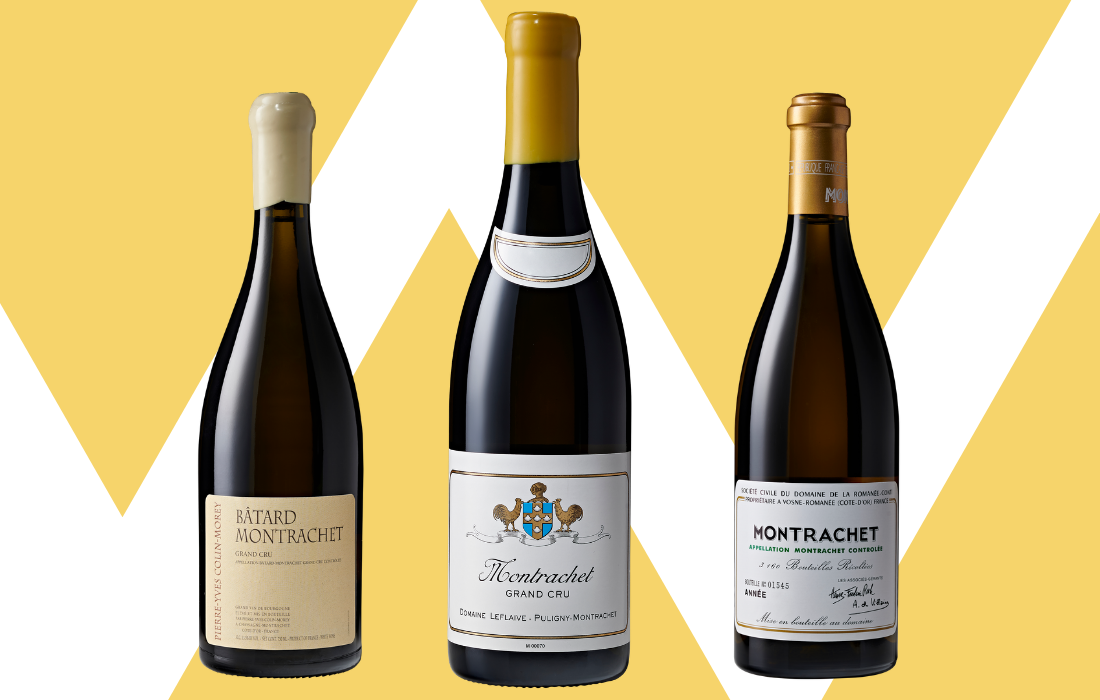
Seven charts on a corner of the fine wine market that has held firm while the broader category corrected.
Prepared for Halie Chavez, Photo Editor, Bloomberg Pursuits.
Over the past decade, two things have happened in fine wine. The broader market has roughly doubled. White Burgundy has more than quadrupled. Its top producers have gone further still.
When fine wine corrected from its 2022 peak, white Burgundy corrected less. When trading activity slowed, white Burgundy deepened. When Bordeaux First Growths lost buyers, white Burgundy gained them. The charts in this pack document that divergence and the market mechanics behind it.
The story isn’t that white Burgundy is expensive. It’s that white Burgundy is now traded as a living, current-drinking asset class — where nearly 90% of all traded value sits in vintages from the last 15 years — not as a cellar category. That’s a different investment profile, and it’s a different kind of market.
Chart guide
White Burgundy has outperformed the broader fine wine market
[Insert Image — inline-image-1]
A price-weighted index rebased to January 2016. White Burgundy has returned +335% over the decade, its top 10 producers +399%, against +107% for the broader fine wine market. All three peaked in 2022; the white Burgundy drawdown of 10% is the shallowest of the three.
White Burgundy has led every major fine wine category over ten years

Cumulative returns across 1, 3, 5 and 10 year windows for five fine wine categories. White Burgundy and its top 10 producers have returned 154% and 165% over ten years respectively, against 41% for Bordeaux First Growths and 80% for the broader fine wine market.

Leflaive accounts for 41% of all top-10 white Burgundy trading

The top 10 white Burgundy producers on CultX, ranked by share of the basket’s combined 5-year trading activity. Domaine Leflaive dominates at 41% — roughly 3x the next closest producer — reflecting the breadth of its range and the weight of buyer demand across Montrachet, Chevalier-Montrachet, and Bâtard-Montrachet.
The white Burgundy market is deepening, not just rising

Monthly trade count and unique wines traded on CultX. Both have more than doubled in five years: trades per month have risen +103% and unique wines per month +87% versus the 2021 baseline. A rising index with a widening tape is the profile of a category gaining liquidity, not losing it.
White Burgundy trades like a living category, not a cellar one
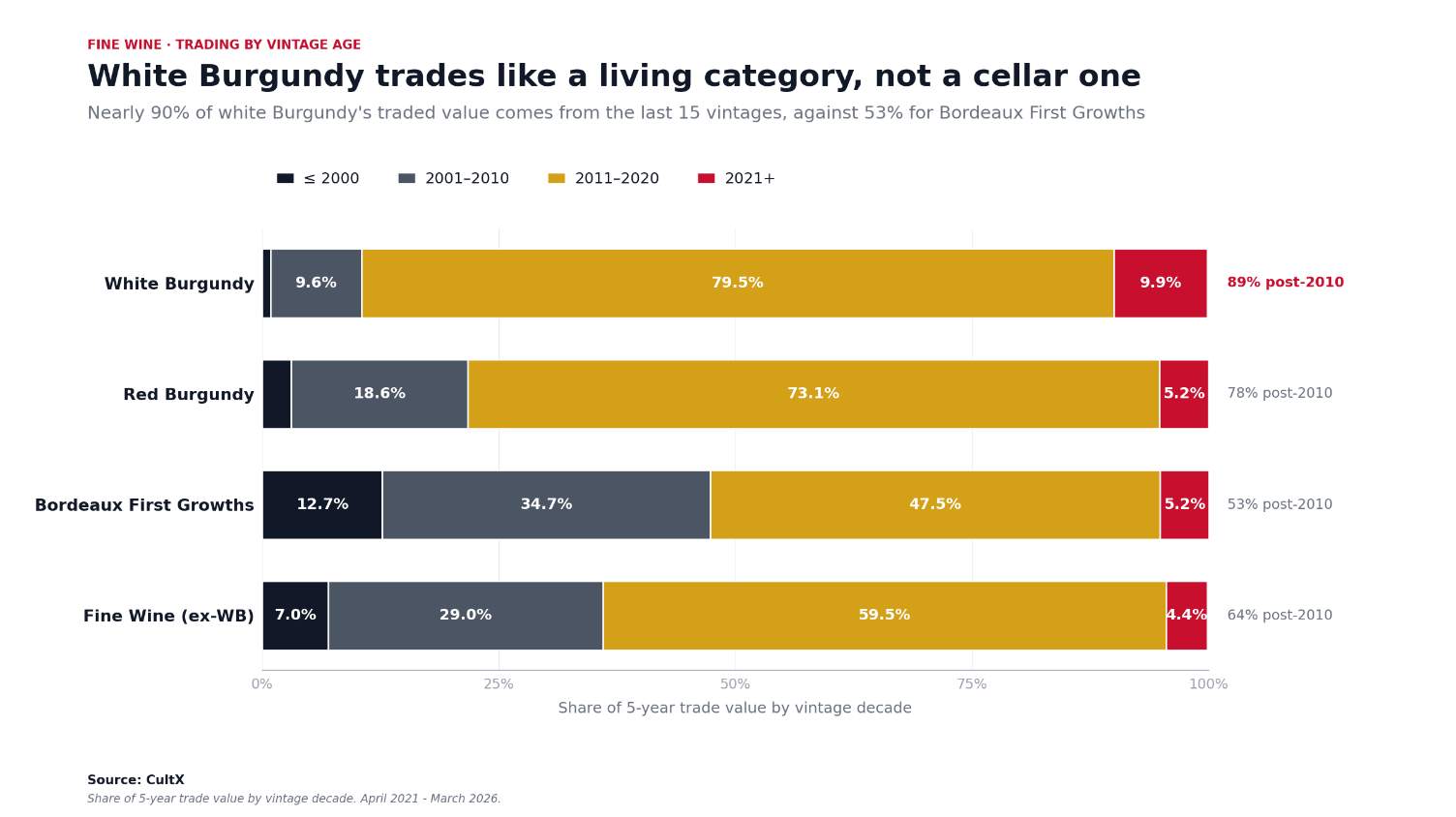
The share of each fine wine category’s 5-year trade value, split by vintage decade. 89% of white Burgundy trading sits in 2011+ vintages, against 64% for the broader fine wine market and only 53% for Bordeaux First Growths. This is the structural story behind the price performance.
A DRC Montrachet 2000 Jeroboam hit £52,500 per bottle

The 15 highest per-bottle prices paid for white Burgundy on CultX over the last five years, expressed as 75cl-equivalent. Domaine de la Romanée-Conti tops the list at £52,500 per bottle for a Jeroboam of Montrachet 2000, followed by Domaine d’Auvenay’s Bâtard-Montrachet at £15,000-£16,500 per bottle. A full top-30 list accompanies this pack as a data table.
Pierre-Yves Colin-Morey leads the producer table with +137% over five years
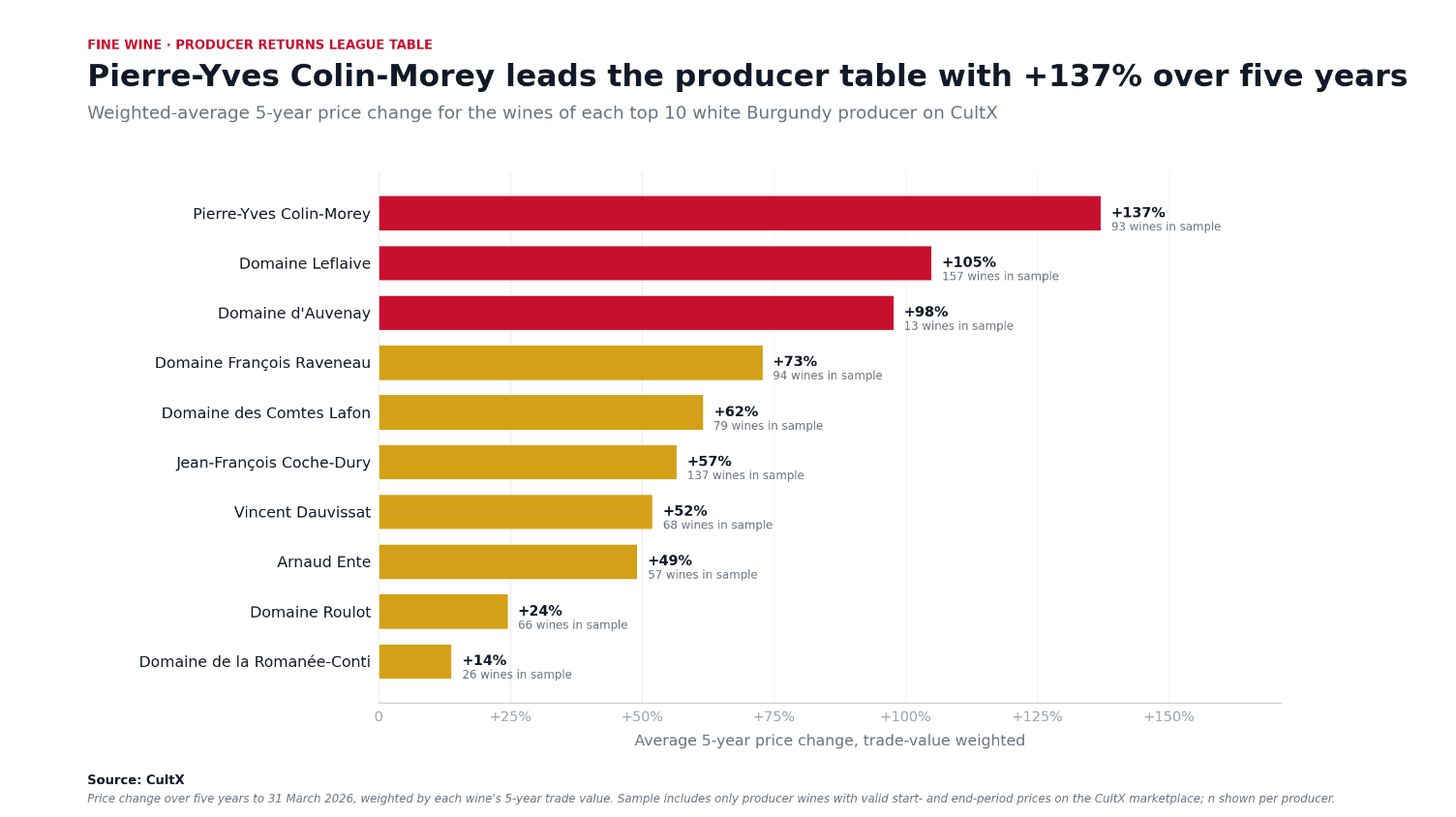
Weighted-average 5-year price change for the wines of each top-10 white Burgundy producer on CultX. Pierre-Yves Colin-Morey leads at +137%, followed by Leflaive (+105%) and d’Auvenay (+98%). Every producer in the basket has delivered positive 5-year returns, with the median producer at around +60%.
Source: CultX, the live fine wine trading marketplace operated by Cult Wines Group, covering more than 200,000 cases across 15,000+ unique wines. All figures are to 31 March 2026, GBP.
Source: CultX, the live fine wine trading marketplace operated by Cult Wines Group, covering more than 200,000 cases across 15,000+ unique wines. All figures are to 31 March 2026, GBP.
This article is for informational purposes only and does not constitute financial, investment, or regulated advice. Fine wine values can fall as well as rise. Past performance is not a reliable indicator of future results. Always conduct your own research before making any investment decision.

Four critics, 112 wines, one vintage: integrating Antonio Galloni, Neal Martin, William Kelley and Jane Anson with CultX release pricing to find where Bordeaux 2025 is mispriced.
Read more ➜
Verified marketplace data from CultX shows strengthening liquidity, rising bid competition and improving trading velocity as the fine wine market moves into a new phase of price stabilisation.
Read more ➜
A pre-release research briefing on the most anticipated Bordeaux vintage in years, built for investors and serious collectors using live CultX market data.
Read more ➜