By
Tom Gearing


While the broader fine wine market has been repricing, white Burgundy has delivered. Over ten years its index has more than quadrupled, its best producers have compounded at double-digit rates, and the secondary market is deeper today than at any point in its history. This is a data-led analyst’s view of what is actually happening, which producers are delivering, and where the allocation opportunities still sit.
By the CultX research desk. All figures are sourced from the CultX marketplace unless stated, with supplementary analysis of Sotheby’s and Acker auction results. Data runs to 31 March 2026. GBP throughout.
Over the past ten years the broader fine wine market has roughly doubled. White Burgundy has more than quadrupled. Its blue-chip producers have done more. When fine wine corrected from its 2022 peak, white Burgundy corrected less. When trading activity slowed across the category, white Burgundy deepened. This is not a narrative being applied to the data. It is what the data says.
The question worth asking in 2026 is not whether white Burgundy is a fine wine investment. It clearly has been. The question is what has driven the resilience, which producers are compounding faster than the rest, and how new capital should be allocated at today’s levels. That is the purpose of this piece.
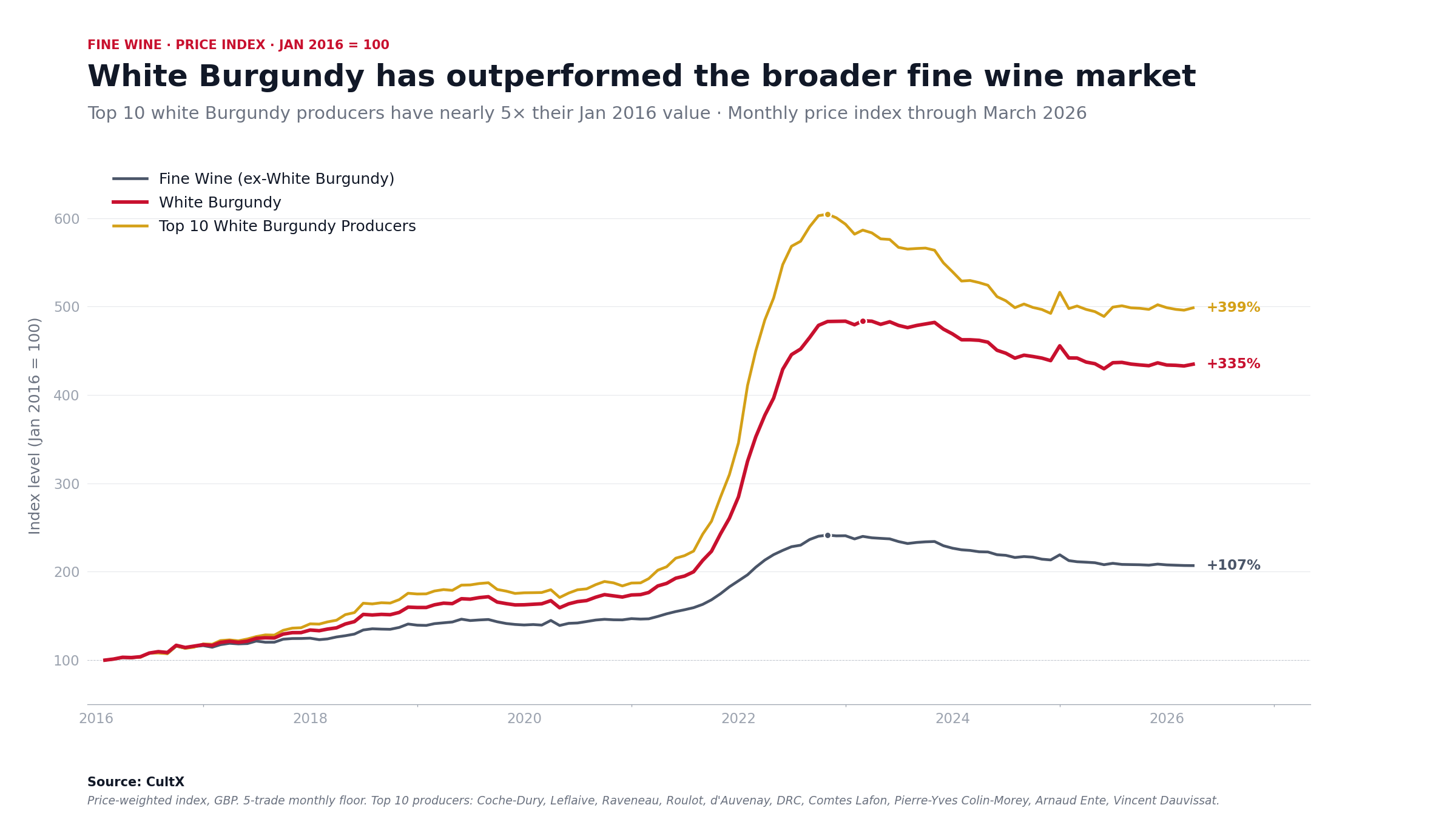
White Burgundy, Top 10 white Burgundy producers, and broader fine wine ex-white Burgundy. Price-weighted index, January 2016 = 100. Source: CultX.
The category index tells a clear story. White Burgundy has returned +335% since January 2016. Its top ten producers, an index of the names considered investment grade by the secondary market, have returned +399%. The broader fine wine market, excluding white Burgundy, has returned +107% over the same period.
All three indices peaked in the final months of 2022, at the top of a post-pandemic rally that pulled broad fine wine to unsustainable levels. What has happened since matters. The broader fine wine market is down 14% from its peak. The top 10 white Burgundy basket is down 17%. White Burgundy as a whole is down just 10%. The category that rallied the hardest has held best in the correction.
This is the first and most important data point of the piece. If you remember nothing else, remember that the shallower drawdown is the structural observation. A category that runs up the most and corrects the least is behaving like a healthy asset class, not a bubble.
The supply side of white Burgundy is one of the most constrained in global wine. Total Grand Cru vineyard across all of Burgundy, red and white combined, covers roughly 525 hectares. That is smaller than a single large Bordeaux estate. Within that footprint, the Grand Cru whites of the Côte de Beaune, Montrachet and its satellites at Chevalier, Bâtard, Bienvenues-Bâtard, Crioats and Corton-Charlemagne, cover a fraction. Montrachet itself is eight hectares. The grand total of commercial production from the appellation in a generous year is perhaps 35,000 bottles, split across seventeen different growers who each own a row or two.
Against that fixed supply, demand has compounded. Global wealth creation since 2010 has produced a population of collectors for whom a case of Chevalier-Montrachet is a plausible purchase. Asian buyers, and Hong Kong specifically, built a sustained presence through the 2010s and have returned in force since late 2024. Climate volatility has tightened supply further, with the 2024 vintage down an estimated 25% on 2023. The producers at the top of the hierarchy, Leflaive, Coche-Dury, d’Auvenay, Ravéneau, Roulot, Ramonet, are effectively impossible to buy at source for anyone without an established allocation.
The arithmetic writes itself. Fixed supply, growing demand, meaningful scarcity at the producer level. That the returns have been strong is unsurprising. That they have been this strong, this consistently, against a backdrop of broader fine wine correction, is the interesting part.
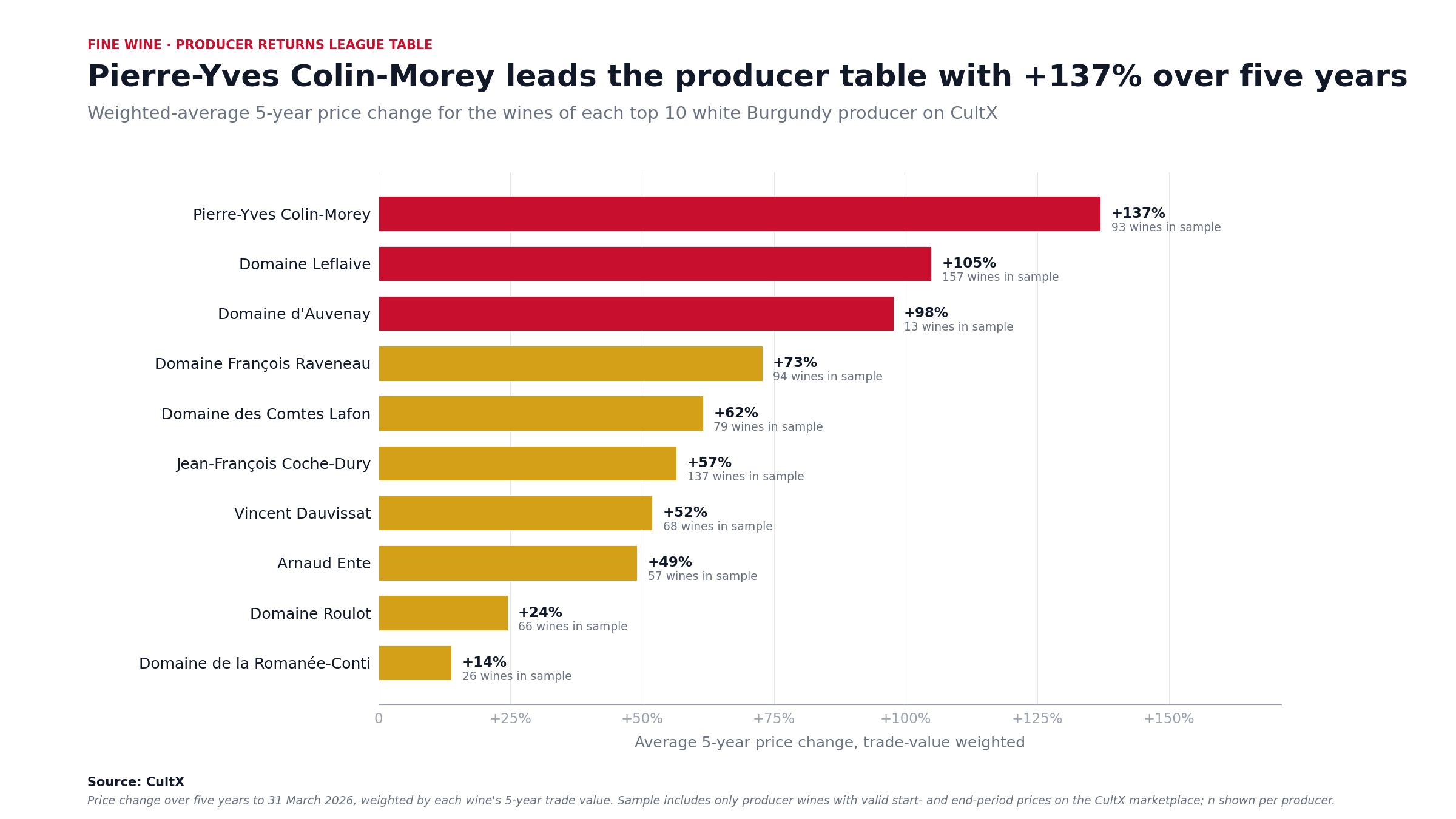
Weighted-average 5-year price change for each producer, trade-value weighted across their wines on CultX. Source: CultX.
We weight each producer’s 5-year price change by the traded value of their individual wines on CultX. That avoids the trap of a single thinly-traded outlier skewing the number. The result is a league table that reflects what the market has actually paid for, not what a handful of illiquid labels have done in isolation.
Pierre-Yves Colin-Morey leads the table at +137%. This is the most analytically interesting name in the top ten. Pierre-Yves established his own domaine in 2004 after a decade at his father Marc Colin’s estate. In a generation he has built a range, from Chassagne Premier Crus up to Corton-Charlemagne, that critics now discuss in the same breath as Coche and Roulot. The market has noticed. Colin-Morey is also strongly present at auction, with 453 lots realising roughly £1.1m across Sotheby’s and Acker in our sample. The CultX weighted return is not a sampling artefact. It is real demand.
Leflaive holds second place at +105%. Biodynamic since 1997, certified since 1998, Leflaive produces the widest blue-chip range in white Burgundy, from a declining Bourgogne Blanc up to multiple Grand Crus. That range is why Leflaive also dominates our Chart 3 with 41% of all top-10 white Burgundy trading on CultX. It is the establishment benchmark.
Domaine d’Auvenay is third at +98%. Lalou Bize-Leroy’s personal estate, tiny production, effectively unobtainable at source. The returns are authentic, though buyers should note that d’Auvenay’s sample size on CultX is the smallest in the top ten, with thirteen wines carrying valid 5-year price data. Auction activity corroborates the story, with 299 lots and £5.16m of realised value.
Ravéneau, Comtes Lafon and Coche-Dury sit in the middle of the table, returning +73%, +62% and +57% respectively over five years on a weighted basis. Ravéneau is Chablis’s one true blue-chip, and the returns reflect the increasing recognition of Grand Cru Chablis as an investment category in its own right. Coche-Dury will surprise some readers by its position here. The explanation lies in the composition of the estate: the Meursault Premier Crus have held firm but the Bourgogne and village-level wines have given back more of their 2022 gains than the investment-grade Corton-Charlemagne. When you weight by traded value, the middle of the range pulls the producer-level number down.
Vincent Dauvissat (+52%), Arnaud Ente (+49%) and Roulot (+24%) make up the next tier. Ente is perhaps the most interesting on an allocation basis. Tiny production, critical adoration, median per-bottle prices at Acker running in the £500s, only 117 lots across both auction houses in our sample. This is a producer where allocation access is the meaningful return vector, not secondary-market flipping.
Roulot’s position at the back of the table needs context. Roulot is one of the most widely held and traded white Burgundy producers on the platform, with 451 auction lots in our sample. The +24% weighted return reflects a producer whose prices rallied earlier in the cycle and have since stabilised. It is a story of slower price appreciation, not thin trading.
Which leaves DRC Montrachet, at +14% weighted on only four trades in our 5-year CultX sample. This is the number that requires the most careful handling, and it is the subject of the next section.
Reading DRC Montrachet through marketplace trading data alone is misleading. To understand why, three facts about the wine need to be held in mind at once.
First, the production volume. Montrachet at Domaine de la Romanée-Conti comes from 0.67 hectares, yielding roughly 3,000 bottles a year for the entire global market. Every other wine in this analysis is produced in multiples of that volume. DRC also released a Corton-Charlemagne commercially for the first time in recent vintages, but the quantity is immaterial and the commercial release history is too short for secondary market analysis.
Second, the distribution structure. DRC distributes globally through a small number of regional agents, each of whom holds allocations in bond on behalf of end collectors. In the UK and Europe specifically, this model holds the wine in controlled warehouses rather than transferring bottles freely to collectors’ private accounts. The commercial logic is deliberate. Agents protect allocations by restricting resale and can penalise collectors who flip wine by reducing or revoking future allocations, tracked through bottle serial numbers. The result is that most DRC Montrachet only enters the secondary market when it leaves bond into private cellars, gets consumed or inherited, and later surfaces at auction.
Third, the release price versus secondary price gap. DRC release prices to allocated collectors are materially below secondary market levels. The carry in an allocation, held rather than flipped, is structural. The gap has widened further over the last decade as secondary prices rose. This creates a peculiar dynamic where the most attractive return profile is restricted to collectors who already hold the allocation, while new capital entering through secondary channels is paying a price that already reflects most of the move.
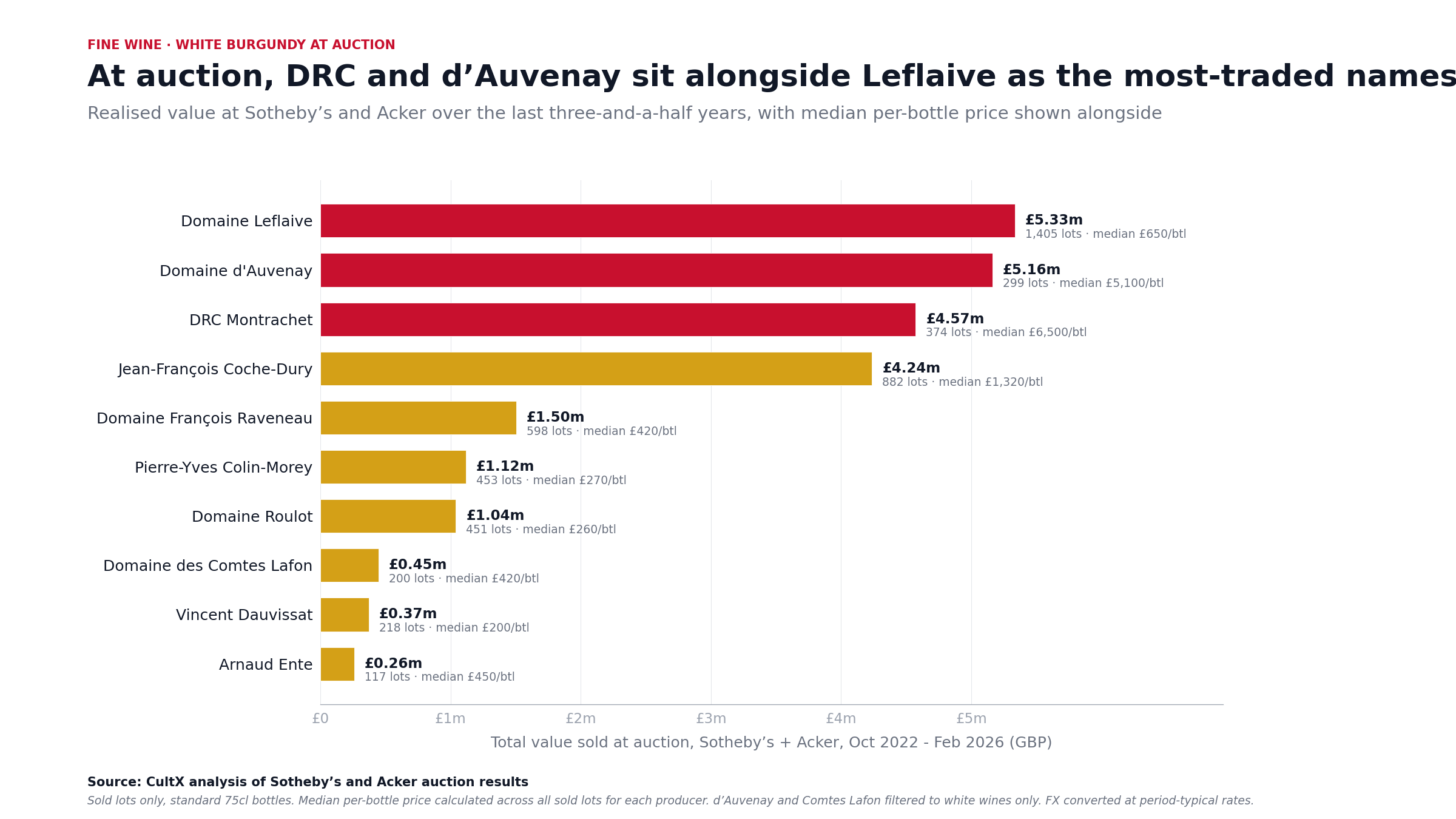
Realised value at Sotheby’s and Acker, October 2022 to February 2026. 75cl lots only. Source: CultX analysis of published auction results.
The auction data completes the picture. Across Sotheby’s and Acker over the last three-and-a-half years, DRC Montrachet has seen 374 sold lots realising £4.57m at a median per-bottle price of roughly £6,500. That places it alongside Leflaive and d’Auvenay as one of the three most traded white Burgundy names at auction. Our CultX bonded trading dataset returned four trades in the same window. Both datasets are accurate. They are measuring different things.

DRC Montrachet is highly liquid in the right channel. In the bonded secondary market it is effectively absent. Investors should select the rail that matches their exit plan before the one that matches their buy plan. For new buyers without allocation access, DRC Montrachet is a trophy position more than a compounding asset. For long-term holders with allocation, it is one of the most structurally privileged positions in global wine.
Two secondary observations follow. Firstly, DRC Montrachet’s post-pandemic correction has been deeper than the rest of the white Burgundy complex. The Liv-ex charting shows this clearly and our own index work confirms it. The rally that lifted DRC to new levels in 2022 is also the reason the give-back has been larger. Secondly, the price appreciation in DRC Montrachet substantially predates the broader white Burgundy rally. Much of the move happened in the 2010s, driven by the Asian collector base, before the wider category caught up. In 2026, buying new allocation exposure to DRC Montrachet is arguably a different investment decision to buying Colin-Morey or Comtes Lafon, where the compounding is still underway.
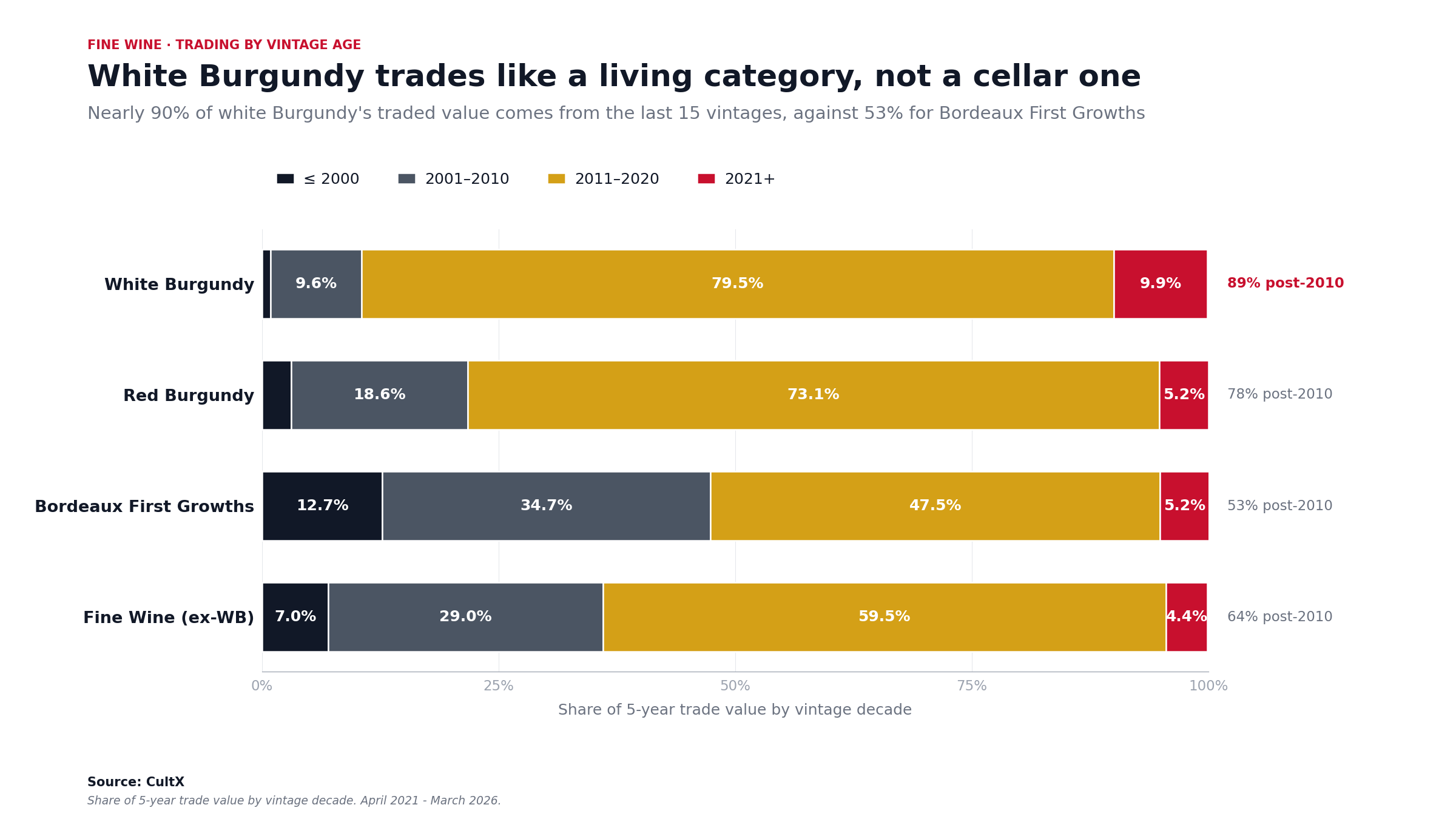
Share of 5-year trade value by vintage decade, across four fine wine categories. Source: CultX.
Here is the structural observation that almost nobody outside the platform data is making. 89% of all white Burgundy trading value on CultX sits in vintages from 2011 onwards. That compares to 64% for the broader fine wine market and just 53% for Bordeaux First Growths. White Burgundy does not trade like a cellared category. It trades like a current, live, drinkable one.
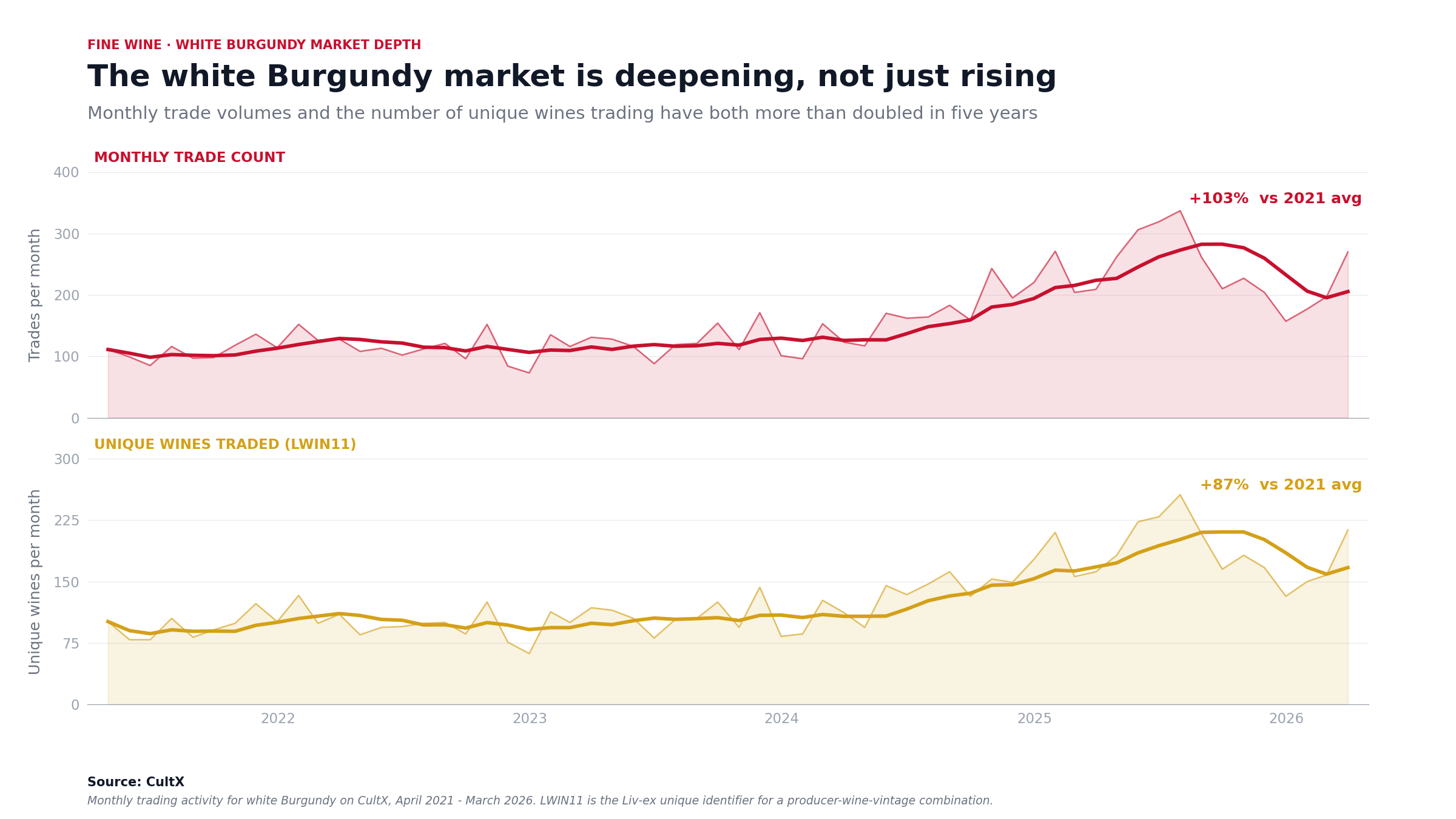
Monthly trade count and unique wines traded on CultX, April 2021 to March 2026. Source: CultX.
The platform-level trading activity confirms it. Over five years, monthly trade count is up 103% and the number of unique white Burgundy wines changing hands each month is up 87%. A rising price index accompanied by a widening tape is the signature of a category gaining liquidity depth, not losing it. This is directly the opposite of what we see in parts of Bordeaux, where rising prices through the rally were accompanied by narrowing participation.
Our reading: white Burgundy is being bought and drunk and bought again, rather than acquired and vaulted for decades. Collectors are treating it as a wine to use, not just to own. That is a different asset profile with three direct implications. Liquidity depth means exit velocity when needed. Active consumption means demand is not purely speculative. And the concentration in recent vintages means allocation cycles are absorbing quickly and reliably, which is the supply-side condition for price stability.
The consensus view on Burgundy entering 2026 is cautious-constructive. Blue chips are stabilising, the correction has created value, 2024 scarcity will help. These are correct observations. Our view is that the consensus understates the strength of the structural picture for white Burgundy specifically.
Three specific points of disagreement.
The 2024 vintage will reach most investor channels through 2026 and 2027. Volumes are down roughly 25% on 2023. That supply shock has not been meaningfully reflected in secondary prices yet, because the 2024s are not yet circulating at scale. The historical pattern is that thin vintages tighten the secondary market for immediately preceding vintages as collectors stretch allocations further. That tightening has not yet happened. It is coming.
A number of commentators have interpreted the 89% post-2010 concentration in white Burgundy trading as a risk flag, on the assumption that older vintages should be traded more heavily if the category is genuinely investment-grade. We read it the opposite way. The post-2010 concentration tells us allocation from the last 15 years is being absorbed and traded actively, rather than sitting dormant. Older vintages are not trading because long-term holders are not selling. That is not a liquidity problem. It is the expected behaviour of a healthy, patient, wealth-holding collector base.
At current levels, white Burgundy divides cleanly into two investment cases. DRC Montrachet and d’Auvenay are trophy positions whose returns are compounding primarily through allocation. Colin-Morey, Leflaive, Ravéneau, Comtes Lafon, Ente and Coche-Dury are compounders whose returns are available to the secondary market. Investors should decide which case they are buying before they buy. The rally is unlikely to carry both groups at the same rate from here.
For investors constructing a white Burgundy position from scratch in 2026, we would suggest three tiers to think about, depending on capital allocation.
Focus on the compounder bucket. A mixed case of Leflaive Bâtard-Montrachet or Chevalier-Montrachet, a half case of Coche-Dury Corton-Charlemagne, and a case of Pierre-Yves Colin-Morey at village or Premier Cru level. The purpose is to own one of each of the three compounder categories: establishment (Leflaive), technical benchmark (Coche), and newer wave (Colin-Morey).
Add exposure to Ravéneau at Grand Cru level, a case of Domaine des Comtes Lafon Meursault Premier Cru, and an Arnaud Ente Puligny-Montrachet. The additions bring in Chablis at the top end (Ravéneau), deepen Meursault representation (Lafon), and introduce a smaller-production name (Ente) whose allocation dynamic is closer to d’Auvenay than to the broad market.
At this level d’Auvenay Bâtard-Montrachet, older-vintage Leflaive Montrachet, and, for investors who understand the auction versus bond distinction, DRC Montrachet enter the portfolio. Trophy positions compound differently to the core book. Hold them as a separate allocation with a longer time horizon and a clear-eyed view that the return may come through holding rather than trading.
White Burgundy has been the category that worked while the rest of fine wine repriced. Its ten-year return has outpaced every major alternative. Its correction has been shallower than the broader market. Its trading activity has more than doubled. Its top producers are compounding at double-digit annualised rates, with the newer wave led by Pierre-Yves Colin-Morey delivering the strongest weighted returns in the league table.
The risks are real and honestly stated. DRC Montrachet is not a liquid compounding asset on the secondary market, whatever its auction prominence suggests. Coche-Dury’s range-wide returns are dragged by the lower-end labels. Roulot has already moved. But the category as a whole, and specifically the middle of the compounder table, is trading at a level where the structural case for allocation remains intact.
Our view, simply stated: in 2026, white Burgundy is the part of the fine wine market where the structural case for allocation is clearest. New capital should concentrate in the compounders. Trophy positions belong in a separate bucket with a longer time horizon. The 2024 vintage scarcity is an unpriced tailwind for back vintages through 2027. And the live-trading nature of the category, 89% of value in recent vintages with deepening volumes, is a feature not a bug. It means the market works.
White Burgundy has been the best-performing major fine wine category over the past decade, returning +335% since January 2016 against +107% for the broader fine wine market. Its correction from the 2022 peak has been shallower than competing categories, and monthly trading activity has more than doubled in five years. For investors with a multi-year horizon, the category remains structurally supported by fixed supply, growing demand, and the scarcity impact of the small 2024 vintage.
On a weighted-average 5-year basis, the strongest-performing producers in the top ten are Pierre-Yves Colin-Morey (+137%), Domaine Leflaive (+105%), and Domaine d’Auvenay (+98%). Ravéneau (+73%), Comtes Lafon (+62%) and Coche-Dury (+57%) sit in the middle of the table. DRC Montrachet’s weighted return is lower on our CultX data, but auction data from Sotheby’s and Acker confirms it remains one of the most heavily traded white Burgundy names globally, with over £4.5m realised in our sample.
White Burgundy entered the 2020s underpriced relative to red Burgundy, with the gap between a typical Grand Cru Chardonnay from Montrachet and an equivalent Pinot Noir from Vosne-Romanée closing rapidly through the rally. Global demand has broadened, with collectors increasingly treating white Burgundy as a primary category rather than a secondary one. The correction from the 2022 peak has also been shallower in whites than reds, reflecting the deeper consumption-driven demand base rather than pure investment buying.
A meaningful core white Burgundy position starts at roughly £10,000, built around a case of Leflaive Bâtard-Montrachet or Chevalier-Montrachet, a half case of Coche-Dury Corton-Charlemagne, and a case of Pierre-Yves Colin-Morey at village or Premier Cru level. This approach balances establishment, technical benchmark, and newer-wave compounder exposure. Investors with more capital can add Ravéneau, Comtes Lafon, and Arnaud Ente to broaden the position, with trophy names like d’Auvenay appropriate above £50,000.
DRC Montrachet is the most prestigious white Burgundy in the world, produced in tiny quantities from 0.67 hectares of vineyard. For investors who hold an allocation directly from a regional agent, it is one of the most structurally privileged positions in global wine, with release prices materially below secondary market levels. For new buyers entering through auction or bonded secondary markets, the investment case is different: much of the long-term appreciation has already been captured, and the recent correction from 2022 peaks has been deeper than for the broader white Burgundy complex. New buyers should treat DRC Montrachet as a trophy allocation rather than a short-term compounding position.
To discuss building a white Burgundy allocation on CultX, or to review specific producers in more depth, contact the CultX research desk.
Past performance is not a guide to future returns. The value of wine investments can rise or fall. This analysis is provided for informational purposes and does not constitute personalised investment advice. Wines referenced may not be available for purchase on the CultX marketplace at all times.
This article is for informational purposes only and does not constitute financial, investment, or regulated advice. Fine wine values can fall as well as rise. Past performance is not a reliable indicator of future results. Always conduct your own research before making any investment decision.

Discover why wine investment is thriving in 2025. CultX offers seamless access to a buyer’s market, long-term growth potential, and innovative tools to build your portfolio with ease.
Read more ➜
Maximise your wine trading by leveraging our unique tools like live offers, community holdings, order books, and liquidity scores, all designed to connect you with motivated buyers and sellers.
Read more ➜
Four critics, 112 wines, one vintage: integrating Antonio Galloni, Neal Martin, William Kelley and Jane Anson with CultX release pricing to find where Bordeaux 2025 is mispriced.
Read more ➜